

Atmospheric Chemistry and Physics
@EGU_ACP
Followers
3K
Following
178
Media
140
Statuses
10K
This account is no longer maintained. Visit our website at: https://t.co/7MQdM2oV9z
Joined July 2014
ACP will shortly be leaving X. To receive alerts of published papers please use our RSS feed. We will announce our future social media plans in due course. Thank you for continuing to support open science publishing.
0
1
2
New research article: Impacts of meteorology and emission reductions on haze pollution during the lockdown in the North China Plain

acp.copernicus.org
Abstract. Haze events in the North China Plain (NCP) during the COVID-19 lockdown underscore the intricate challenges of air quality management amid reduced human activities. Utilizing the WRF-Chem...
0
1
1
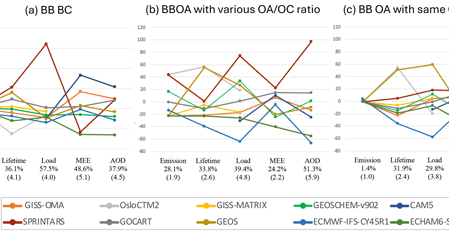
New research article: Biomass burning emission analysis based on MODIS aerosol optical depth and AeroCom multi-model simulations: implications for model constraints and emission inventories
acp.copernicus.org
Abstract. We assessed the biomass burning (BB) smoke aerosol optical depth (AOD) simulations of 11 global models that participated in the AeroCom phase III BB emission experiment. By comparing...
0
3
2
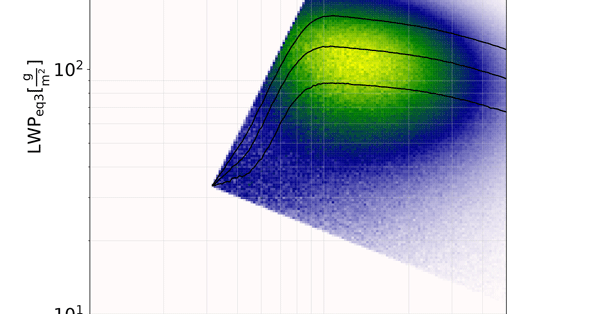
New research article: Model analysis of biases in the satellite-diagnosed aerosol effect on the cloud liquid water path
acp.copernicus.org
Abstract. The response in cloud water content to changes in cloud condensation nuclei remains one of the major uncertainties in determining how aerosols can perturb cloud properties. In this study,...
0
2
8
Discussion open for comments on @EgUsphere: Prior heterogeneous ice nucleation events increase likelihood of homogeneous freezing during the evolution of synoptic cirrus
0
0
1
Discussion open for comments on @EgUsphere: Impacts of aerosol-radiation and aerosol-cloud interactions on a short-term heavy rainfall event – A case study in the Guanzhong Basin, China
0
0
2
New article: Technical note: Recommendations for diagnosing cloud feedbacks and rapid cloud adjustments using cloud radiative kernels
acp.copernicus.org
Abstract. The cloud radiative kernel method is a popular approach to quantify cloud feedbacks and rapid cloud adjustments to increased CO2 concentrations and to partition contributions from changes...
0
0
1
Discussion open for comments on @EgUsphere: The effect of organic nucleation on the indirect radiative forcing with a semi-explicit chemical mechanism for highly oxygenated organic molecules (HOMs)

egusphere.copernicus.org
Abstract. Highly oxygenated organic molecules (HOMs) can significantly contribute to new particle formation (NPF). HOMs-derived NPF in preindustrial (PI) environments provides the baseline for...
0
0
1
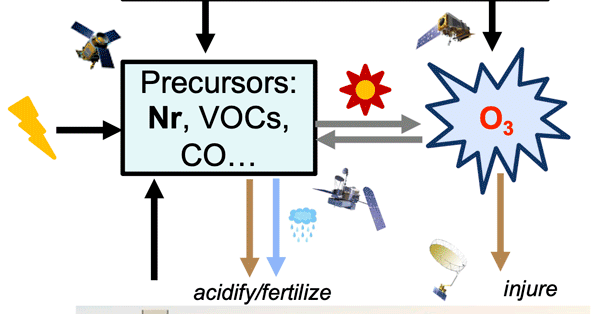
New research article: Reactive nitrogen in and around the northeastern and mid-Atlantic US: sources, sinks, and connections with ozone
acp.copernicus.org
Abstract. This study describes the application of a regional Earth system model with updated parameterizations for selected land–atmosphere exchange processes and multiplatform, multidisciplinary...
0
0
1
Discussion open for comments on @EgUsphere: Current-use and organochlorine pesticides' multi-annual trends in air in Central Europe: primary and unidentified secondary sources
0
0
1
Discussion open for comments on @EgUsphere: Evaluating urban methane emissions and their attributes in a megacity, Osaka, Japan, via mobile and eddy covariance measurements
0
0
1
Discussion open for comments on @EgUsphere: Measurement Report: Polycyclic aromatic hydrocarbons (PAHs) and their alkylated (RPAHs), nitrated (NPAHs) and oxygenated (OPAHs) derivatives in the global marine atmosphere: occurrence, spatial variations, and...
0
0
1
Discussion open for comments on @EgUsphere: The importance of stratocumulus clouds for projected warming patterns and circulation changes
0
0
1
Discussion open for comments on @EgUsphere: Characteristics, main sources, health risks of PM2.5-bound perfluoroalkyl acids in Zhengzhou, central China: From seasonal variation perspective
0
0
0
Discussion open for comments on @EgUsphere: Influence of modes of climate variability on stratospheric gravity waves in the tropics using Radio Occultation and Reanalysis Data
0
0
0
Discussion open for comments on @EgUsphere: Failed cyclogenesis of a mesoscale convective system near Cape Verde: The role of the Saharan trade wind layer among other inhibiting factors observed during the CADDIWA field campaign
0
0
1
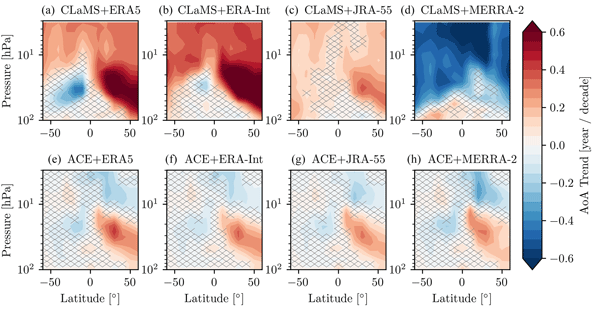
New research article: Hemispheric asymmetry in recent stratospheric age of air changes
acp.copernicus.org
Abstract. Many stratospheric trace gases, including O3, HCl, and NOy, have had opposing trends in the Southern Hemisphere (SH) compared to the Northern Hemisphere (NH) during the last 2 decades. Some...
0
0
0
New research article: Atmospheric oxidation of 1,3-butadiene: influence of seed aerosol acidity and relative humidity on SOA composition and the production of air toxic compounds
acp.copernicus.org
Abstract. This study investigated the effect of relative humidity (RH) on the chemical composition of gas and particle phases formed from the photooxidation of 1,3-butadiene (13BD) in the presence of...
0
0
1
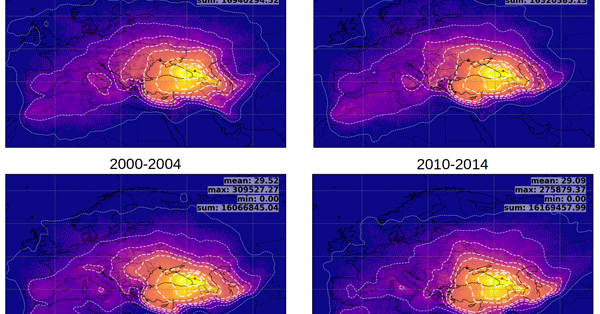
New measurement report: Measurement Report: Changes in ammonia emissions since the 18th century in south-eastern Europe inferred from an Elbrus (Caucasus, Russia) ice-core record
acp.copernicus.org
Abstract. Atmospheric ammonia (NH3) is a key transboundary air pollutant that contributes to the impacts of nitrogen and acidity on terrestrial ecosystems. Ammonia also contributes to the atmospheric...
0
0
1
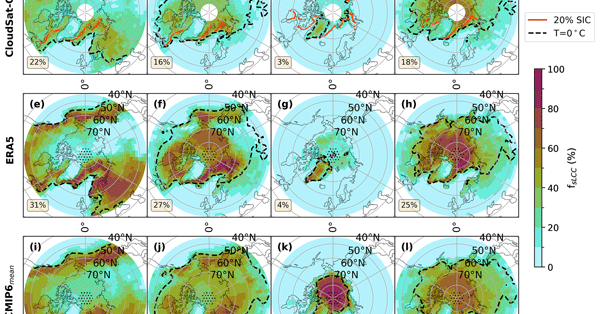
New research article: Evaluation of biases in mid-to-high-latitude surface snowfall and cloud phase in ERA5 and CMIP6 using satellite observations
acp.copernicus.org
Abstract. Supercooled liquid-containing clouds (sLCCs) play a significant role in Earth's radiative budget and the hydrological cycle, especially through surface snowfall production. Evaluating...
0
0
2