Anik Sharma
@CosmicAnik
Followers
2K
Following
198K
Media
27K
Statuses
54K
Astronomy✨ Star Trek🖖 Carl Sagan🌟 Sci Fi🚀 Lost in inner space, dreaming of outer space🚀💫✨ Citizen of the Sol System❤🌎🇺🇦
Earth (Terra), Sol System
Joined June 2021
"I, a Universe of Atoms An Atom in the Universe Made of ✨StarStuff✨ Floating on a Mote of Dust Lost between Immensity And Eternity of space time Just like YOU My fellow cosmic being"☺️💫🌟 LLAP🖖
13
52
283
What does a supernova look like? This visualization simulates the first 150 milliseconds of a supernova. As the star collapses in on itself, hot gas emits from its core in uneven shock waves. Researchers use computer simulations like this to more accurately understand the
5
24
109

“There was a time before television, before motion pictures, before radio, before books. The greatest part of human existence was spent in such a time. Over the dying embers of the campfire, on a moonless night, we watched the stars.” ― Carl Sagan
4
65
241
It's a common belief that nearly every galaxy has a giant black hole at its core - but a recent study using @chandraxray has shown that most smaller galaxies may not. Read more about these findings here: https://t.co/hth33ah1XM
1
18
96
Stunning. 😍
0
1
15
Wishing YOU✨️🌟✨️ A Lovely Evening✨️💫✨️ And a Wonderful Weekend ahead💖🖖
0
0
1
He’s red for an amazing reason! This dwarf galaxy named Markarian 178 has a mostly blue hue, but a collection of rare massive stars gives the galaxy glowing patches of red. Learn more about this @NASAHubble image: https://t.co/2xgYU9vQxi
217
890
3K

A spectacular, unrivalled view of Messier 106 (Credit: KPNO/NOIRLab/NSF/AURA/PI: M.T. Patterson/T.A. Rector, M. Zamani & D. de Martin)
3
13
42
"Literature is the most agreeable way of ignoring life." ― Fernando Pessoa
14
244
1K
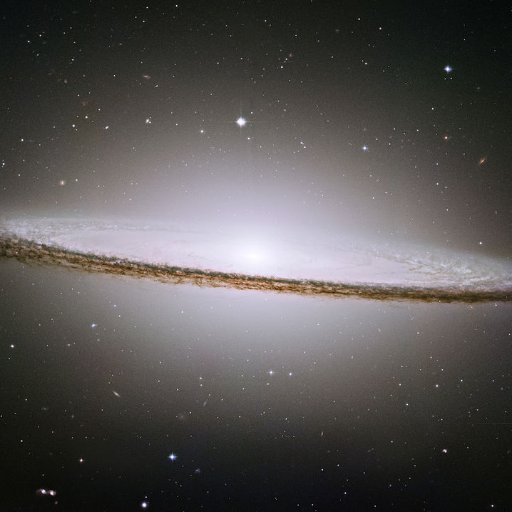
Spectacular: NGC 3981 The sprawling, irregular shape of its spiral arms is likely a result of gravitational interactions with a neighbouring galaxy Credit: Dark Energy Survey/DOE/FNAL/DECam/CTIO/NOIRLab/NSF/AURA - Image processing: R. Colombari & M. Zamani (NSF’s NOIRLab)
0
35
130

New research from the University of Rochester shows that over billions of years, small amounts of Earth’s atmospheric particles have been transported to the Moon’s surface, guided by the interaction of the solar wind with Earth’s magnetic field. Charged particles knocked loose
7
19
131