
Chandra Observatory
@chandraxray
Followers
414K
Following
13K
Media
5K
Statuses
78K
Official Twitter account of NASA’s Chandra X-ray Observatory. Operated for NASA by Smithsonian (SAO). Verification: https://t.co/oQRMjHqCRI Legal: https://t.co/BUQNO29Sjg
In orbit
Joined January 2008
Tired from all that Thanksgiving cooking? Don't worry, many black holes can cook for themselves today! Black hole outbursts, in the form of jets, can trigger a series of events that ends up allowing these monsters to prepare their own meals & self-feed! #BlackHoleFriday ⚫ (1/2)
13
106
474

I couldn’t decide between deck-builder or city-builder... so I made BOTH. A cozy but compelling roguelite city-builder where you place buildings from your deck to settle islands. Unlock, swap and combine technologies to twist core rules and discover powerful card combos.
1
8
108
Before fall leaves, we're celebrating autumn all this week with seasonal offerings from space! We hope the glowing pockets of gas & dust in NGC 6334 remind you of leaves tossed around by the wind, but we know you're already thinking about untangling holiday lights, aren't you?👀
16
154
700
IC 348 is a star-forming region located about 1,000 light-years from Earth in our Milky Way galaxy. The wispy structures that dominate this image are interstellar material that's reflecting light from stars. The fluffy-looking colored dots are developing young stars.✨
21
133
476
That fuzzy, purple smudge is a distant black hole growing at one of the fastest rates ever seen. It's located roughly 12.8 billion light-years from Earth, which means that we're seeing it as it was just ~920 million years after the universe began. More: https://t.co/7633y46GG0
31
159
659
Westerlund 1 is the biggest and closest "super" star cluster to Earth. Some of the stars found here shine with the brightness of almost one million Suns! This new image combines X-ray light from Chandra, optical light from @NASAHubble, and infrared light from @NASAWebb.
36
391
1K
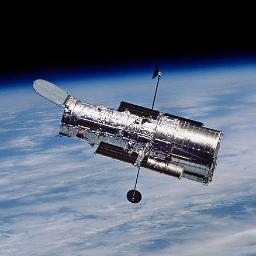
NGC 346 is homebase for thousands of newborn stars! 🌟 The cluster’s most massive stars produce powerful winds and radiation. In this image, Hubble's visible & ultraviolet observations are combined with X-ray data from @chandraxray. Find more: https://t.co/Nf6BUbQj6L
42
406
2K
The star that exploded to become the Cassiopeia A supernova remnant appears to have undergone a dramatic event right before its demise. New evidence from Chandra indicates that the star's interior was violently rearranged just hours before the explosion: https://t.co/oRUQuulAaX
19
254
887
X-ray & radio light go "hand in hand" in this new image of MSH 15-52. Nicknamed "the hand of god" in popular culture, new data are providing us with a fresh view of this exploded star, its environment, and its peculiar properties. More: https://t.co/kgGic1J3ml 🤝
35
261
1K
The "ink-redible" Squid Galaxy is located about 50 million light-years from Earth. This view of the Squid, roughly 29,000 light-years across, combines different types of light captured by NASA's Chandra, @NASAHubble, @NASAWebb, and @TheNRAO's Very Large Array.🦑
42
326
2K
M82 is a so-called "starburst galaxy" — a galaxy where stars are forming at rates 10s to 100s of times higher than in normal galaxies like our Milky Way. This image of M82, roughly 27,000 light-years across, combines observations from @NASA's Chandra and @NASAHubble.
32
240
898

A quick midnight snack @NASAHubble and @ChandraXray caught a black hole having a feast about 450 million light-years away. Data points to it being an intermediate-mass black hole, which are harder to spot than supermassive black holes. https://t.co/2Ekenvgd3d
325
819
5K
NASA's Chandra and Hubble have teamed up to identify a rare type of black hole eating a star. When it comes to black holes, Chandra & @NASAHubble are like peanut butter and jelly — even better when they're together! More at: https://t.co/4l6eOWPtAE ⚫
13
138
549
What you're seeing is a 98-light-year-wide chunk of star factory. This new image of N79, a giant region of star formation located about 160,000 light-years from Earth, combines observations from NASA's Chandra X-ray Observatory and @NASAWebb .✨
22
280
1K
A star is bombarding a baby planet with X-rays, shrinking it from the size of Jupiter to a small, barren world, according to a new Chandra study. Scientists estimate the planet is losing a mass equivalent to a full Earth's atmosphere about every 200 years. https://t.co/Qs3xtxlvwi
15
139
627
To infinity and beyond! Scientists using NASA's Chandra & Webb have discovered an oddly-shaped galaxy resembling the infinity symbol ♾️ that may contain the first newborn supermassive black hole ever spotted. The buzz: https://t.co/ufi0gNUXWn
13
160
580
The Bullet Cluster is iconic, having provided the first direct proof of dark matter with NASA's Chandra, Hubble, and ground-based telescopes back in 2006. This spectacular new image combines Chandra & Webb Telescope data — helping us learn more about dark matter than ever before.
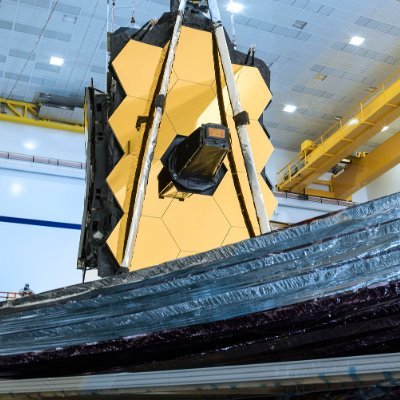
Hello darkness my old friend… What you are (not) seeing, highlighted in blue, is dark matter. Webb was used to precisely map out the dark matter that is part of the makeup of two colliding galaxy clusters. https://t.co/Qxb3O8jOuP
13
116
478
This new image shows the Andromeda Galaxy in 5 different types of light — X-ray, UV, optical, infrared, and radio. Andromeda, also known as Messier 31 (M31), is the closest spiral galaxy to the Milky Way at a distance of about 2.5 million light-years. https://t.co/EdOhaXhGHb
17
358
1K
Today Chandra is studying a not so itsy bitsy spider that's making big waves. Located about 3,000 light-years from Earth, the Red Spider Nebula is home to one of the hottest stars known. The star produces powerful stellar winds, generating waves about 100 billion kilometers high.
17
167
638
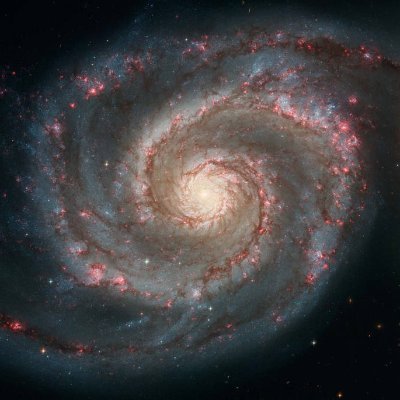
Is it bad luck if a black hole crosses your path? #FridayThe13th It depends on how close you get! Maybe you’ll safely fly by, like in this simulation …
14
61
220