

Carroll Lab
@Carroll_Lab_Ox
Followers
945
Following
168
Media
79
Statuses
377
We study emerging viruses, including Ebola Virus, CCHF, Mpox and SARS-CoV-2. Part of @PSIOxford and @HumanGeneticsOx
University of Oxford
Joined September 2021

Excellent talk on Ebola persistence and vaccination from Miles @Carroll_Lab_Ox—we really need to have more conversations about vaccine durability and boosting. #19vaccinecongress
1
4
47
Our lab is attending the @uk_icn AGM this week - look out for out talks! Developing nanobodies as pan-SARS-CoV-2 therapeutics by Luke Jones, today (22/7) at 14:00 High prevalence of sarbecovirus in a single bat roost in Gloucestershire, UK by Dung Nguyen - thursday 24/7 at 9:45
0
1
5
14/ This work emphasises the need to integrate virology, epidemiology, and survivor-focused policy to confront EBOV persistence. Future filovirus control will depend as much on understanding within-host dynamics as it does on zoonotic surveillance.
0
0
0
13/ Citation: Meek et al. Ebola virus persistence: implications for human-to-human transmission and new outbreaks. Explor Med. 2025.
explorationpub.com
Ebola virus (EBOV) infection usually leads to highly lethal EBOV disease (EVD) with associated viraemia. Viraemia is cleared in those that do survive, however, EBOV may remain hidden in the testes a
1
0
0
12/ Conclusion: EBOV persistence—particularly in the testes—poses a rare but high-impact threat to global health. Understanding, detecting, and treating this hidden reservoir is essential for future outbreak prevention and survivor care.
1
0
0
11/ Implications: – Outbreaks can originate from humans, not just zoonoses – Long-term viral reservoirs complicate eradication efforts – Persistent EBOV challenges current outbreak definitions and requires rethinking public health strategy
1
0
0
10/ Key future directions: – Develop testicular in vitro models to study EBOV persistence – Expand semen studies using standardised protocols – Conduct remdesivir phase 3 trials – Investigate female and MSM transmission routes – Monitor post-EVD sequelae linked to persistence
1
0
0
9/ Male-to-male sexual transmission remains unexplored in the literature, despite evidence from other viruses suggesting elevated risk via anal intercourse. The authors call for confidential, unbiased contact tracing and NHP challenge studies.
1
0
0
8/ Vaccination of survivors is unlikely to prevent recrudescence due to already high antibody titres. Ring vaccination of contacts remains the more promising strategy and has shown success in outbreak containment.
1
0
0
7/ Remdesivir shows promise in reducing EBOV RNA in semen, but trials to date are underpowered. A phase 3 trial in future outbreaks is a critical research priority, alongside further evaluation of favipiravir at higher dosing.
1
0
0
6/ Despite WHO guidelines, adherence to safe sex and breastfeeding advice is limited by stigma and socioeconomic factors. There is a clear need for long-term follow-up, semen testing, and community-based education to mitigate transmission risk.
1
0
0
5/ Mechanisms of persistence remain unclear. Three main theories are proposed: – Polymerase mutations reducing viral replication – Defective interfering genomes – Lack of immune pressure in IPNs Of these, polymerase mutation is supported by most evidence.
1
0
0
4/ Recrudescence (reactivation of virus in IPNs) has caused severe disease, especially meningoencephalitis and uveitis, in multiple survivors. These events are rare but clinically severe and capable of igniting new transmission chains.
1
0
0
3/ Sexual transmission from persistent virus has previously started outbreaks, including a 2021 outbreak traced to a male survivor infected 5 years prior. Genomic data confirmed the virus was not from a new zoonotic spillover but from the 2013–2016 lineage.
1
0
0
2/ Persistence is best characterised in semen. Longitudinal cohort studies show EBOV RNA can be detected for up to 988 days. Meta-analysis estimates ~7 of 5,000 male survivors may still be shedding at 5 years post-infection (95% CI: 0–43).
1
0
0
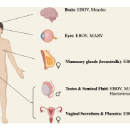
1/ The 2013–2016 West Africa EBOV epidemic revealed a critical paradigm shift: EBOV can persist in immune privileged niches (IPNs) such as the testes, brain, and eyes for months to years after recovery, with potential for delayed transmission.
1
0
0
📣Publication alert 📣 A new review in Exploration of Medicine by Oliver Meek, Kimberly Fornace & Miles Carroll addresses the long-term persistence of Ebola virus (EBOV) in survivors and its implications for transmission and outbreak control. Thread with key findings below 🧵:
1
0
3
13/ Citation: Nguyen et al. SARS-CoV-2 infection enhancement by amphotericin B: implications for disease management. J Virol (2025).

journals.asm.org
AmB and nystatin are common treatments for fungal infections but were predicted to strongly interact with SARS-CoV-2 proteins, indicating their potential modulation or inhibition against the virus....
0
1
1
12/ More broadly, this work underscores the importance of validating in silico drug repurposing predictions with rigorous mechanistic and functional assays. Computational hits may have unanticipated off-target effects in the context of viral co-infections.
1
0
0
11/ Key conclusions: - AmB and nystatin enhance SARS-CoV-2 entry and replication in vitro - Enhancement is mediated by interference with IFITM3 antiviral function - Caution is warranted when using AmB in patients with active COVID-19 - Alternative antifungals should be considered
1
1
0