
Stijn Glorie
@CDurango4
Followers
99
Following
41
Media
7
Statuses
45
thermochronologist @ University of Adelaide
Adelaide, South Australia
Joined October 2019
Alejandra’s PhD chapter on the cooling history of the Petermann is out. We demonstrate heat production needs to be considered when interpreting Rb-Sr dates:
0
0
0
We have an exciting PhD opportunity in Adelaide. Sharing is caring :) https://t.co/q3YsykSo3D
0
1
1
New approach to age constrain BIFs using authigenic phosphate! Apatite Lu − Hf dating of late Archean banded iron formations
0
0
1

Discussion open for comments: A comparison between in situ monazite Lu–Hf and U–Pb geochronology
gchron.copernicus.org
Abstract. In complex metamorphic rocks, monazite U–Pb dates can span a wide concordant range, leading to ambiguous geological interpretations (e.g. slow protracted cooling versus multiphase growth)....
0
2
7
New paper on-line by Birk Härtel, of relevance to the detrital community: finite-mixture modelling is not always the answer!: Ghost age components in detrital thermochronology
0
2
3
New paper by Alex on in situ Re-Os dating, demonstrating a new and effective (lower interference) reaction recipe. Check it out: LA-ICP-Q-MS/MS ReOs geochronology: A comparison of N2O and CH4 reactio...
0
0
3

Just a general call to say that I am looking for graduate students (MS/PhD) to join NSF funded projects focused on tectonics + low-T thermochronology at @ougeosciences. If you're interest and like to know more, feel free to reach out via email. Details: https://t.co/6CGZrFm0Yj
0
14
23

Ok now we most likely know where the Chicxulub projectile came from… Ruthenium isotopes show the Chicxulub impactor was a carbonaceous-type asteroid | Science

science.org
An impact at Chicxulub, Mexico, occurred 66 million years ago, producing a global stratigraphic layer that marks the boundary between the Cretaceous and Paleogene periods. That layer contains...
2
10
52
Belgian article on the Stonehenge discovery: https://t.co/Qwk8kKAEhI
@anthony__clarke @TimescalesEPS
0
0
1

The centre of solstice activities at Stonehenge is the Altar Stone – a large sandstone slab of uncertain origins. New work from experts at @CurtinUni and @UniofAdelaide has found a match for it all the way in Scotland. https://t.co/7Wa1bq8C2s
theconversation.com
The centre of solstice activities at Stonehenge is the Altar Stone – a large sandstone slab of uncertain origins. Our new work has found a match for it all the way in Scotland.
0
2
8
The Altar Stone of Stonehenge came from an unexpectedly distant place, new study reveals https://t.co/JCg2AC7JmT via @ConversationEDU @anthony__clarke @TimescalesEPS @UniofAdelaide @CurtinUni @ChronKirkland
theconversation.com
The centre of solstice activities at Stonehenge is the Altar Stone – a large sandstone slab of uncertain origins. Our new work has found a match for it all the way in Scotland.
0
0
3

📢 A mountain-building event on the paleo-Pacific margin of Gondwana occurred 590 million years ago: https://t.co/j2Xy8qo0MD
0
3
7
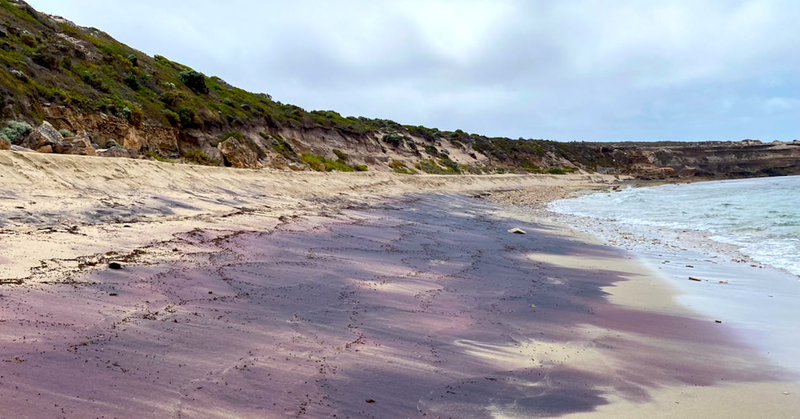
South Australia’s enigmatic pink sand was born in ice-covered Antarctic mountains, new research shows https://t.co/iFb89m10kL via @ConversationEDU
theconversation.com
The hunt for the origin of garnet crystals found on South Australian beaches took researchers thousands of kilometres and half a billion years back in time to a hidden Antarctic mountain range.
0
0
2
Sharmaine’s first PhD chapter is published, resolving the mystery of pink sands on South Australian shores! Spoiler alert: they were born in the guts of a newly discovered orogeny under the Antarctic ice:
nature.com
Communications Earth & Environment - A mountain-building event on the paleo-Pacific margin of Gondwana occurred 590 million years ago, based on detrital garnet geochronology of modern sands and...
0
0
6
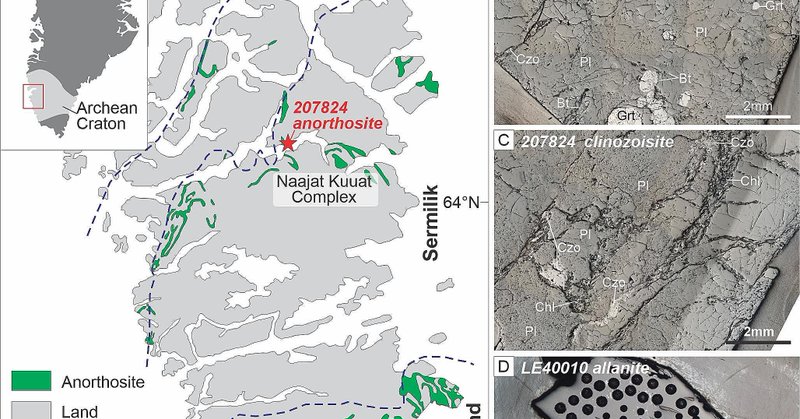
New Lu-Hf paper, expanding the range of dateable minerals! https://t.co/QwRpRzsu2x
link.springer.com
Contributions to Mineralogy and Petrology - Epidote group minerals, including allanite, clinozoisite and epidote are common in a range of metamorphic, igneous and hydrothermal systems, and are...
0
5
19
New paper illustrating the power of the Lu-Hf method to mineral exploration and deposit research: In situ apatite and carbonate Lu-Hf and molybdenite Re-Os geochronolog...
0
4
9
Great new paper on the nutrients for early life, featuring a 3.7 Ga in situ Re-Os date!: Macdonald - 2024 - Geobiology - Wiley Online Library

onlinelibrary.wiley.com
On the anoxic Archean Earth, prior to the onset of oxidative weathering, electron acceptors were relatively scarce, perhaps limiting microbial productivity. An important metabolite may have been...
0
1
5
Anyone interested in In situ beta decay dating by LA-ICP-MS/MS might find this review chapter useful:
0
0
6
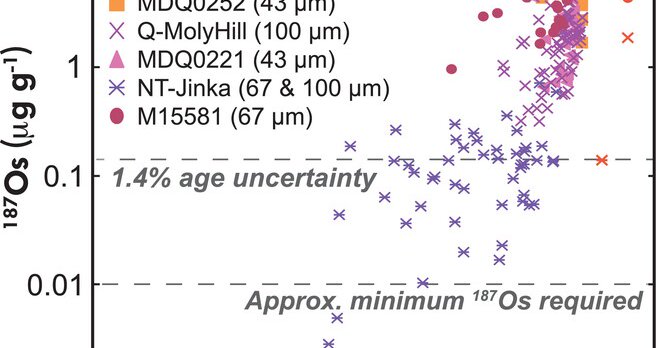
Hot from the press! New paper led by Renee on: Molybdenite Reference Materials for In Situ LA‐ICP‐MS/MS Re‐Os Geochronology - Tamblyn - Geostandards and Geoanalytical Research - Wiley Online Library
onlinelibrary.wiley.com
Methodology for in situ Re-Os LA-ICP-MS/MS includes separating Os from Re with methane. Two new matrix-matched in situ molybdenite reference materials have been developed. Uncertainties on weigh...
0
1
7
Alejandra’s PhD paper just got online: Apatite Triple Dating (Lu–Hf, U–Pb, FT) Constrains Deformation and Cooling in the Coompana and Madura Provinces, Western Australia https://t.co/ms0ikqIL6P 14/lithosphere_2023_292/637044/Apatite-Triple-Dating-Lu-Hf-U-Pb-FT-Constrains
0
2
3