
Benjamin Peterson
@BigMicrobeBen
Followers
316
Following
378
Media
104
Statuses
352
Assistant Professor - School of Freshwater Science at UW-Milwaukee. Contaminant and microbial biogeochemistry. Great Lakes. https://t.co/o9z75gxUWG
Joined January 2016
First shipment of supplies into the new lab! Can't wait to put these new toys to use.
0
0
6
As projects develop, I will be looking to recruit graduate students, undergraduates, and postdocs starting in 2025. If you or someone you know is interested in any or all of these topics, stay tuned for these opportunities!
1
0
4
My lab will focus on contaminant and microbial biogeochemistry, with a specific emphasis on mercury and the Great Lakes region. We will be highly collaborative and use an interdisciplinary approach, with research programs in both environmental and culture-based study systems.
1
1
4
I'm excited to share that today was my first day as an Assistant Professor in the School of Freshwater Sciences (@waterscienceUWM) at UW - Milwaukee! I am very excited to join the great faculty at this one-of-a-kind program, especially in my home state and a city I love.
6
4
99

As permafrost thaws, its massive stores of mercury leach into the environment. @BigMicrobeBen of @UCDavis will use advanced microbial methods to understand the effect of permafrost-derived carbon on the microbial communities that produce toxic methylmercury.
1
2
4
For more info on the system and the USGS project: USGS Fact Sheet: https://t.co/Zlmm7yV9Rs MeHg loads to and export from the Hells Canyon Complex: https://t.co/OGWNJsrOmW Impact of biogeochemistry on Hg fate: https://t.co/wMmtk5LTeK More studies in prep!
1
0
0
This builds on previous work (see references in manuscript) to suggest that mercury methylation might occur at higher redox conditions than previously thought, which has implications for management strategies to reduce mercury levels in ecosystems and in aquatic food webs.
1
0
0
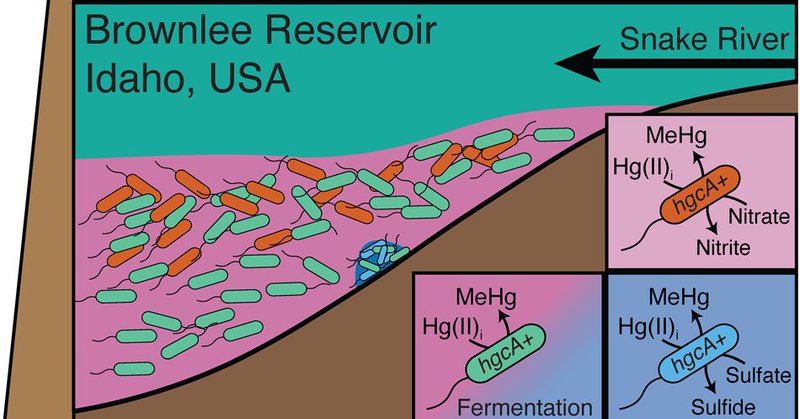
By pairing these data with assembly-based and genome-resolved metagenomics, we identified fermentative and nitrate-reducing microbes carrying the methylation gene hgcA.
1
0
0
Long story short, we leveraged hydrologic and biogeochemical data with great spatial and temporal coverage to show that methylmercury formation within the water column of the reservoir, when nitrate was still present, was an important source of MeHg to the system.
1
0
0
Another dissertation chapter in print! We joined a massive U.S. Geological Survey project, investigating mercury cycling in a hydroelectric reservoir along the Snake River, to identify the microbes methylating mercury under nitrate-reducing conditions. https://t.co/kOcrflaj50
nature.com
The ISME Journal - Metabolically diverse microorganisms mediate methylmercury formation under nitrate-reducing conditions in a dynamic hydroelectric reservoir
1
8
22
Our first seminar is tomorrow 🙂 join us

Join us for our first seminar on 24 Feb with @caitlin_gio as speaker. You can join us at mersorcium@gmail.com or here https://t.co/hcORWdhBLO for Zoom id. Looking forward to meet with all of you :)
0
2
6

Submit an abstract to our special special "Meta-omic and geochemical approaches to linking microbial activity to biogeochemical mercury cycling" - Abstracts due Feb 28! #ICMGP2022
0
5
11
Join us for our first seminar on 24 Feb with @caitlin_gio as speaker. You can join us at mersorcium@gmail.com or here https://t.co/hcORWdhBLO for Zoom id. Looking forward to meet with all of you :)
0
7
13
The world lost a great one yesterday. Gonna miss you Woodsie, I was lucky to have had the opportunity to call you "coach". https://t.co/aVwRGOXJJn
0
0
3

For context, we're order some ZnOAc to make a 1% ZnOAc solution for preserving sulfide samples in the field. So the question is particular to general lab solutions, but also interested in hearing about the difference in other situations.
0
0
0