

Adrian Stier
@AdrianStier
Followers
3K
Following
25K
Media
979
Statuses
7K
Ecologist and Conservation Biologist. PI @oceanrecoveries lab | Focus: ocean ecosystem resilience. | @ucsantabarbara | he/him/his
Santa Barbara, CA
Joined June 2011
New paper alert! We just published a massive meta-analysis in @Ecology_Letters asking: How does crowding affect survival in reef fish populations? The answer? It's way more complicated than we thought. 🧵 Thread on what 147 studies taught us (1/8)
1
0
1
Bottom line: Population regulation isn't a fixed property—it's contingent on ecological context. Want to dive deeper? 📖 Paper: https://t.co/dcrqB7GTcC Big thanks to @OsenbergLab and everyone who shared their data! 🙏 (8/8)
onlinelibrary.wiley.com
Across 147 estimates from 38 nearshore fish species, we find striking heterogeneity in density-dependent mortality—including frequent sign reversals within species. Context dominates: effects are...
0
0
0
Why does this matter? Understanding density-dependence is crucial for: 🔹 Managing fisheries 🔹 Conserving endangered species 🔹 Predicting how populations respond to disturbance (hello, climate change) But we can't predict what we don't understand. (7/8)
1
0
0
Here's the kicker: Most studies don't report the environmental details we need to understand WHY results vary so much. It's like trying to predict weather without knowing temperature, pressure, or humidity. We need better reporting! 📊 (6/8)
1
0
0
Finding #3: Rare species feel it more 📉 Species that naturally occur at LOW densities showed STRONGER density-dependence. This makes sense—if you're not adapted to crowding, adding neighbors hits harder. Think: introvert at a packed party 😅 (5/8)
1
0
0
Finding #2: Context is everything 🌊 The same species showed wildly different responses depending on: Predator density Shelter availability Habitat complexity Even the SIZE of fish when the study started Location, location, location! (4/8)
1
0
0
Finding #1: Predators are game-changers 🦈 When predators were present, density-dependent mortality was ~15× stronger than without them. Why? At high densities, fish compete for hiding spots—and those left exposed become snacks. (3/8)
1
0
0
For decades, ecologists have known that when fish populations get crowded, mortality often increases—a key mechanism regulating populations. But here's what surprised us: the STRENGTH of this effect varied by 1000-fold, even within the same species! 🤯 (2/8)
1
0
0
These aren't hypothetical scenarios. We examined Pacific hake, petrale sole, and sablefish on the US West Coast. Between 2005-2022, estimated unfished biomass changed by 25-65% as stock assessments incorporated new data every 1-4 years.
0
0
0
imilar story with carrying capacity. When it dropped, adaptive management increased harvest 36% but reduced biomass 22%. The inverse happened when carrying capacity rose. Not a win-win—a trade-off.
1
0
0
The pattern was consistent: when productivity declined, adaptive management maintained populations 42% larger but reduced harvest. When productivity increased, adaptive rules boosted cumulative harvest by >100% but kept populations ~40% smaller.
1
0
0
We modeled what happens when climate gradually changes fish productivity (how fast populations grow) and carrying capacity (how many fish the environment supports). Then compared fixed management rules vs adaptive ones that update as conditions shift.
1
0
0
Our new study by @jamealfsamhouri @PLOSClimate reveals an uncomfortable truth about climate-ready fisheries: adaptive management strategies can boost population biomass OR harvest—but rarely both. The 'right' choice depends on what we value as a society. https://t.co/Chy0bvziFh
1
0
2
Coral spawning = nature’s biggest party 🎉🌊 But while corals release their eggs + sperm into the night, a hidden guest list shows up hungry… 🦀⭐🐚🦪 @TomShlesinger reveals crabs, barnacles, brittle stars & more secretly feasting on coral spawn. https://t.co/DlsN8xcmYO
1
0
0
🦈 Sharks, skates, and rays aren’t locked into slow, “fixed” life histories. New work in Ecology Letters shows they can shift to higher reproductive output when food availability increases — a surprising plasticity in elasmobranch biology! 👉
onlinelibrary.wiley.com
We analysed life history traits of 151 elasmobranch species for two contrasting feeding levels in a principal components analysis. Two axes, reproductive output and generation turnover, structure...
0
0
2
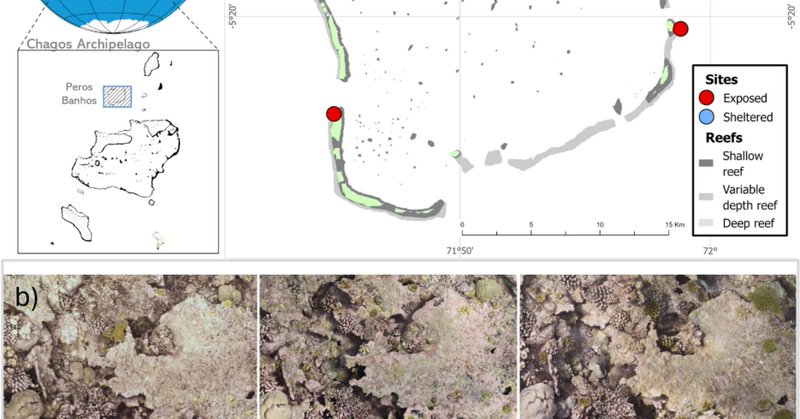
Stratford et al. tracked >1,000 coral “babies” in the remote Chagos Archipelago after bleaching. Survival & growth were high, but after 3 yrs they still made up just 2.4% cover. Even “ideal” reefs recover painfully slow. 🌊🌱 👉
link.springer.com
Coral Reefs - As coral reefs face increasingly frequent and severe disturbances, their condition relies more heavily on recovery dynamics. Understanding reef recovery is essential for assessing the...
0
0
1
Take-home: Indonesia’s reefs may be showing more resilience than expected, but cover alone doesn’t capture species shifts, functional change, or hidden vulnerability.
0
0
0
3/ The “shifted baseline” point is key: most data begin after the 1998 global bleaching event. What looks “stable” may already reflect reefs that declined before monitoring began.
1
0
0