
Guoqing Zheng
@zzzzgq
Followers
106
Following
87
Media
1
Statuses
33
Research Scientist at Percepta AI | Ex: Principal Researcher at @MSFTResearch.
Joined March 2009
Join us at NeurIPS for a happy hour on AI transformation, co-hosted by Percepta, GC and @nvidia: RSVP at https://t.co/6af38RxjlJ, and solve some fun puzzles at https://t.co/kaKAK2ECYu to skip the waiting list!

invite.generalcatalyst.com
Hosted by Percepta, General Catalyst, NVIDIA
0
2
6

Today marks an important milestone. I’m launching Percepta together with @htaneja, @hirshjain, @tmathew0309, Radha Jain, @marisbest2, @KonstDaskalakis and an incredible team, with the goal of bringing AI to the core industries that run our economy. For AI to deliver
percepta.ai
Transforming critical institutions using applied AI. Let's harness the frontier.
10
20
86

Excited to release our first set of reasoning models Phi-4-reasoning and Phi-4-reasoning-plus, available today on HuggingFace and Azure AI foundry. Some interesting insights below and more deep dives in following days!
1
10
42

New Phi-4 reasoning models have been released. Offer performance that is comparable to GPT-4o and o3-mini! https://t.co/S2ErrUHJVA
#AIReasoning #GenAI #AI #Phi4 #OpenAI #AzureOpenAI

azure.microsoft.com
Microsoft continues to add to the conversation by unveiling its newest models, Phi-4-reasoning, Phi-4-reasoning-plus, and Phi-4-mini-reasoning. Learn more.
0
2
8

Introducing Phi-4-reasoning, adding reasoning models to the Phi family of SLMs. The model is trained with both supervised finetuning (using a carefully curated dataset of reasoning demonstration) and Reinforcement Learning. 📌Competitive results on reasoning benchmarks with
4
34
141
We’ve been cooking... a new open weights 14B Phi-4 reasoning model, SFT’d on ~1.4M carefully curated reasoning demonstrations from o3-mini and RL’d for a tiny bit. This model is a little beast.
36
239
1K
We are hiring interns to work on LLM reasoning for summer 2025! Apply at

How do you train reasoning models? What's the role of verifiers, RL, and synth data generation? How do these fit in multi-agent workflows? To find out, come join us for an internship at MSR AI Frontiers. Link below :D
0
1
8
What is reasoning? Do LLMs use it? Does it help? Is o1 really that better than sonnet? How do you even measure all that? MSR AI Frontiers is working to figure it all out, and we're looking for interns to work on evals to better understand LLMs. Please apply!! Link below:
4
8
143

#Orca I'm thrilled to announce our latest work on Generative Teaching: generating vast amount of diverse high-quality synthetic data for language models to teach a specific skill (e.g. RC, text classification, tool use,math) without the extensive human effort typically required
4
9
44
With Orca, we're excited about the potential of redefining the reasoning capabilities of smaller LLMs. We're still at the beginning phases of this intriguing journey, but our preliminary explorations have yielded encouraging results. 1/7
5
13
40
Cleanly labeled and weakly labeled data are both crucial to few-shot NLU. WALNUT features a unified setting with both few-shot and weakly supervised learning. We hope to bring more attention to semi-weakly supervised learning for NLU. #NAACL2022 #NLProc
@MSFTResearch

Our paper entitled "WALNUT: A Benchmark on Semi-weakly Supervised Learning for Natural Language Understanding" got accepted in #NAACL2022. Joint with @zzzzgq @gkaraml and @AhmedHAwadallah, from Microsoft Research and Columbia. Stay tuned!
0
0
2
paper: https://t.co/1Gp0GIbtlF, code: https://t.co/oCsNM1WLMP. Joint work fom Microsoft, Dartmouth and Northwestern.
github.com
Knowledge Infused Decoding. Contribute to microsoft/KID development by creating an account on GitHub.
Integrating knowledge to NLG typically requires training/fine-tuning PLMs on knowledge sources. With KID, we show it's viable to infuse knowledge on the fly in decoding phase without requiring modifications to the LMs. Check out our #iclr2022 work on Knowledge Infused Decoding.
1
1
1
Integrating knowledge to NLG typically requires training/fine-tuning PLMs on knowledge sources. With KID, we show it's viable to infuse knowledge on the fly in decoding phase without requiring modifications to the LMs. Check out our #iclr2022 work on Knowledge Infused Decoding.
0
1
4
Two new NLU benchmarks for robust evaluation of PLMs.

Current benchmarks may yield imprecise readings of AI models’ natural language understanding. Two new NLU benchmarks aim for more accurate evaluations. #NeurIPS2021
0
0
1

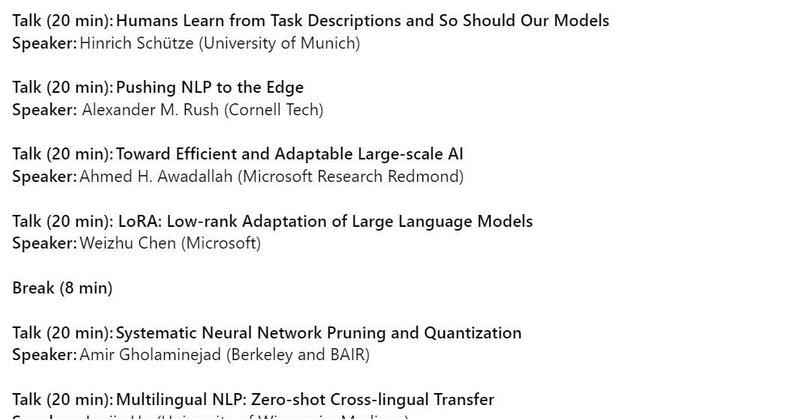
Open to everyone! The first-ever 2021 Microsoft Research Summit, Oct 19 - 21, with over 150 sessions across 16 tracks, provides the global research community with an opportunity learn from experts pushing the frontiers of technology. Register now:… https://t.co/cK5qBSomc4
linkedin.com
Open to everyone! The first-ever 2021 Microsoft Research Summit, Oct 19 - 21, with over 150 sessions across 16 tracks, provides the global research community with an opportunity learn from experts...
0
3
7
Just released a new survey on prompting methods, which use language models to solve prediction tasks by providing them with a "prompt" like: "CMU is located in __" We worked really hard to make this well-organized and educational for both NLP experts and beginners, check it out!

What is prompt-based learning, and what challenges are there? Will it be a new paradigm or a way for human-PLMs communication? How does it connect with other research and how to position it in the evolution of the NLP research paradigm? We released a systematic survey and beyond
1
54
216
Excited to share our recent work on leveraging meta-learning for cross-lingual transfer.

MetaXL is a new method for cross-lingual transfer to extremely low-resource languages that works by meta-learning transformation functions to improve gradient alignment between source and target languages. See our #NAACL2021 paper! https://t.co/tf61zMEjQ8 1/2
0
0
2
0
0
0

An Equivalence between the Lasso and Support Vector Machines http://t.co/31go7AqTTl
0
6
14