Camilo A. Calderón Acevedo
@camiloandresAC
Followers
798
Following
12K
Media
77
Statuses
2K
Colombiano🇨🇴 Ph.D. #CientíficoCriollo Mastozoólogo—filogeografía, sistemática y conectividad 🦇🐿https://t.co/zNQood0YGL; RTs ≠ endorsements.
Joined December 2010
We've launched LongBAT, a long-term census of bats in Panama's Soberanía National Park, mirroring the 50-year bird census. Join us in studying how environmental changes impact these amazing creatures! #LongBAT #BatCensus #Panama #Conservation
stri.si.edu
1
6
11

¡EL CAFÉ NOS UNE! ☕️ Gana café de especialidad, achiras huilenses y pocillo peltre. Reglas: - RT este tuit - Etiqueta a 3 amigos 2 GANADORES el LUNES 17, 6 PM. ¡Lleva lo mejor de #Huila a tu casa! 🔥
58
115
175
Que café más bueno! El Bourbon Rosado es delicioso, ahora a probar el nuevo Java de Ikonoclasta Café @cafe_con_alba
1
1
5
Salgo YAAAA pa Yarumal ! 💥💥💥
🚨 COMPARTAN esta noticia y PEGUEN YA pa @elparaisodelosquetzales donde Luz Dary en Yarumal, Antioquia !! . Scytalopus stilesi, el tapaculito endémico de la Cordillera Central 🇨🇴 saliendo divino en comederos 🔥🔥🔥 . ☎️ +57 320 6279805 & @elparaisodelosquetzales
0
2
10

Easy access to the List of Mammal Species of Colombia using #mammalcol #R package 📦 - Explore Colombia’s 553 species of mammals - https://t.co/QaOtuh5PiY
@SCMas2 @camiloandresAC
0
3
12
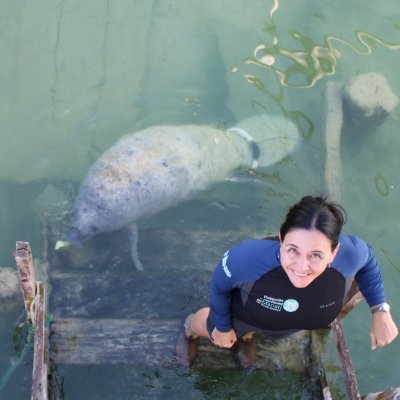
Para quienes desean acabar con los zoos y otros cautiverios para animales, inicio un hilo de casos COMPROBADOS sobre como los centros de tenencia de fauna bajo cuidado humano son una herramienta fundamental para la conservación de fauna. Por favor colaboren con más casos.
41
428
958
🚨COMPARTAN este video: POR PRIMERA VEZ, el hormiguero Gymnocichla nudiceps es posible en comederos… visiten @secretodelbosquebirding en Doradal, Antioquia para ver esta y MUCHAS otras especies interesantes 🔥 . 📸 gracias a @santiago.nature por las fotos
0
4
20
NUNCA ANTES VISTO… compartan !!! 💥💥💥💥
🚨COMPARTAN este video: POR PRIMERA VEZ, el hormiguero Gymnocichla nudiceps es posible en comederos… visiten @secretodelbosquebirding en Doradal, Antioquia para ver esta y MUCHAS otras especies interesantes 🔥 . 📸 gracias a @santiago.nature por las fotos
1
1
3

New paper out! We found that in pipistrelle bats, social vocalizations carry a stronger phylogenetic signal than echolocation calls, suggesting the former evolve more slowly, while the latter remains flexible and shaped by the environment. https://t.co/i5btFfv0mG
2
11
25
10/10 🧵Read the full paper to dive deeper into our methods & findings! https://t.co/6TBNIpxncV if you don't have access to it, you can request it via Researchgate.
researchgate.net
Request PDF | Nectar drinking efficiency in lonchophylline and glossophagine bats: are “pump-like” or “mop-like” tongues better? | Nectarivory has independently evolved twice in the bat family...
0
0
1
9/10 🧵In conclusion: Tongue extension seems to be a better predictor of nectar extraction efficiency than tongue morphology itself. More species data are needed to generalize, but this study sheds new light on bat-flower co-evolution! #Science #Biodiversity
1
0
1
8/10 🧵Despite these behavioral and morphological differences, our results suggest that both "pump-like" and "mop-like" tongues are surprisingly comparable in their nectar extraction abilities across various floral shapes. Adaptation in action!
1
0
0
7/10 🧵Glossophagines (mop-tongues) increased their visit duration to get more nectar from deeper flowers. But Lonchophylla robusta (pump-tongue) actually decreased visit duration with deeper nectar, showing a sharper drop in consumption. Fascinating behavioral differences!
1
0
0
6/10 🧵Key finding 2: Nectar depth is a challenge for all! As nectar got deeper, extraction efficiency declined at a similar rate for all species. But how they dealt with it was different...
1
0
0
5/10 🧵Even within the Anoura species, individuals with longer tongues were more efficient at extracting nectar. This suggests that tongue length is a crucial factor for these amazing pollinators!
1
0
0
4/10 🧵Key finding 1: Tongue extension matters! We found a strong link between maximum tongue extension and nectar extraction efficiency across all species. Lonchophylla robusta, with intermediate tongue extension, showed intermediate efficiency.
1
0
0
3/10 🧵We studied 3 co-existing species in the Ecuadorian Andes: 2 glossophagines (Anoura caudifer, A. cultrata) and 1 lonchophylline (Lonchophylla robusta). Using flight-cage experiments, we measured tongue extension & nectar extraction efficiency across different flower types.
1
0
0
2/10 🧵 In the bat family Phyllostomidae, nectarivory evolved twice, leading to two distinct tongue types: the "mop-like" (lapping) tongues of glossophagines & the "pump-like" (grooved) tongues of lonchophyllines. What does this mean for efficiency?
1
0
0
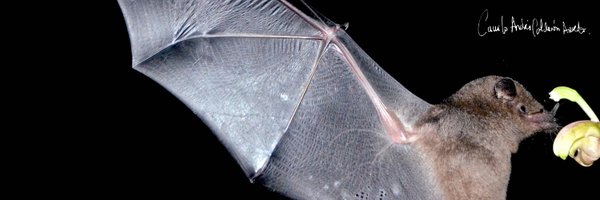
1/10 🧵🦇🌺Our latest study(@DianaGamba @Muchhala_Lab)dives into the amazing world of nectar-feeding bats & their super specialized tongues! Ever wondered how different bat species get their nectar?#BatResearch #Pollination #Ecology
https://t.co/6TBNIpxncV
https://t.co/aTVY404IAQ
1
0
3
8/10 🧵Despite these behavioral and morphological differences, our results suggest that both "pump-like" and "mop-like" tongues are surprisingly comparable in their nectar extraction abilities across various floral shapes. Adaptation in action!
0
0
1
7/10 🧵Glossophagines (mop-tongues) increased their visit duration to get more nectar from deeper flowers. But Lonchophylla robusta (pump-tongue) actually decreased visit duration with deeper nectar, showing a sharper drop in consumption. Fascinating behavioral differences!
1
0
1