

Armin Scheben
@arminscheben
Followers
725
Following
6K
Media
38
Statuses
676
Postdoc in Computational Biology at Cold Spring Harbor Laboratory. Doing comparative genomics, mostly in🌱. Sharing cool #science.
Joined April 2016

Postdoc position in my group in Tokyo! Please get in touch if you are interested. And happy to discuss projects - ranging from developing new methods to analysis of new genomes that we are now sequencing in the lab. https://t.co/RurkIGI2TC Lab page:
3
38
67

Hello world! I have a postdoc position immediately available in my lab. It will focus on identifying high-quality transposons in many genomes and finding their impacts in evolution and traits. Most works, including EDTA2 development and annotation of 400+ genomes, are done! 1/n
5
48
118
New genetic barcoding technology developed at @WeillCornell can help CSHL researchers map where metastatic prostate cancer spreads, and maybe one day roadblock cancer. @asiepel @arminscheben
cshl.edu
Metastatic cancer can be a devastating diagnosis. The cancer is spreading. It may travel to multiple organs in the body. This could mean more pain and ultimately, death. Unfortunately, just how...
0
3
8
How TEs gain and lose between tropical and temperate maize inbreds? We found that tropical corns have 35Mb more TEs than temperates, and it's mainly due to a small number of LTR families that are young, less methylated, and more expressed in tropical maize. https://t.co/LbZDKwlkjN
1
27
91

PlantCaduceus - Cross-species modeling of plant genomes Led by Jingjing Zhai and Aaron Gokaslan, with the Kuleshov lab, we’re having our “ChatGPT moment” with DNA Large Models. PlantCaduceus predicts functional DNA sequences with single base resolution across flowering plants.
1
21
38
So great to see this paper out in @Nature. Beautiful molecular characterization of a new toxin-antidote drive system in maize, led by Ben berube, with assistance from Martienssen lab @antnerves @CrisAlves_bio @BioJlynn and collaborators @arminscheben @jrossibarra Jerry Kermicle

Why was corn able to spread and adapt so rapidly across the Americas 4,000 years ago? Research from CSHL’s Rob Martienssen suggests that the answer may lie in a genetic system called Teosinte Pollen Drive.
1
10
31
Very excited to be starting my group this autumn at https://t.co/aBIREK5Ck3
@RIKEN_JP and we’re hiring! https://t.co/KMHG7Tpe7f Many more fellowship opportunities as well, please get in touch if interested and see you in Tokyo!
12
46
169
Had an invigorating day of scientific presentation and discussion at Friday's #NYAPG24 meeting with @Stephen_Stak. The poster sessions on a rooftop were a great opportunity to draw in the plant-curious crowd and reconnect with old friends and poster neighbors like @JianjunJin.
0
1
10

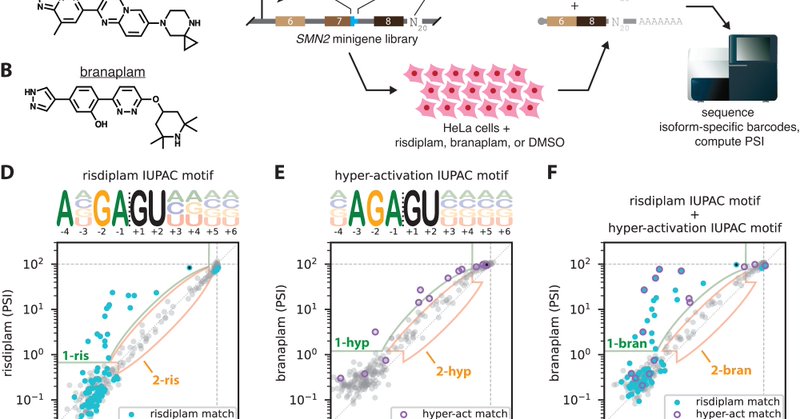
I'm excited to share our latest research on the mechanisms of splice-modifying drugs. We studied how two small-molecule drugs, risdiplam and branaplam, work. The results challenge the existing understanding of these two drugs.
nature.com
Nature Communications - Two small-molecule drugs, risdiplam and branaplam, have been developed for treating spinal muscular atrophy. Here the authors develop quantitative modeling methods for the...
5
27
102
The MaizeCODE paper is on BioRXiv! New insights on enhancers in plants and a lot of data for every maize (epi)geneticist to play with, including on teosinte, the ancestor of maize. A big team effort, very grateful to everyone involved! https://t.co/rlOlxUJbWX

biorxiv.org
Modern maize was domesticated from Teosinte parviglumis , with subsequent introgressions from Teosinte mexicana , yielding increased kernel row number, loss of the hard fruit case and dissociation...
4
25
69

MaizeCODE reveals bi-directionally expressed enhancers that harbor molecular signatures of maize domestication. https://t.co/IxRRwWQTts
#biorxiv_plants
0
8
14

Thread about a new preprint from the lab, led by Logan Whitehouse and Dylan Ray, about tree-sequences. The teaser tagline: why use tree sequences for evolutionary inference when you can directly examine population genetic alignments?
biorxiv.org
As population genetics data increases in size new methods have been developed to store genetic information in efficient ways, such as tree sequences. These data structures are computationally and...
2
18
46

Half a million models + many duck jokes later, I'm excited to share the preprint for nQuack: https://t.co/4zWOdfLVgc This project started as a paragraph in a paper with @JLandisBotany, @RobertLaport, and @desert_hopping. But morphed into a new method and package. (1/n)

biorxiv.org
Premise Traditional methods of ploidal level estimation are tedious; leveraging sequence data for cytotype estimation is an ideal alternative. Multiple statistical approaches to leverage DNA sequence...

.@ShellyGaynor introduces nQuack, a program to ID autopolyploids w/sequencing data - many theoretical advantages over similar tools like nQuire. Will be available on GitHub soon! Very grateful for folks like Shelly who do the math so I don’t have to… #Botany2023
3
15
62

Interested in cutting-edge genomics, pan-genomics, and crop bioinformatics? 🌱💻 Join our newly established Computational Plant Biology group at TUM! We're excited to see your application. Please spread the word! Apply now: https://t.co/k7KX3OCZNZ
#Genomics #Bioinformatics #TUM
6
55
92
Great to return to San Diego for #PAG31 to present my work on constraint and divergence in the noncoding genomes of maize and its relatives in the 'Comparative Genomics' workshop today at 10.30am. Looking forward to lots of conversations on genomics and beyond.
0
4
56

Super excited about our new paper entitled ‘Convergence in carnivorous pitcher plants reveals a mechanism for composite trait evolution’ just out in @ScienceMagazine and featured on the cover!
18
223
1K

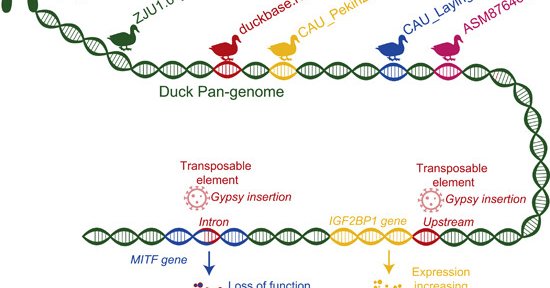
Happy to share our recent work publishing in a rising journal @iMetaScience . Duck pan‐genome reveals two transposon insertions caused bodyweight enlarging and white plumage phenotype formation during evolution. And thanks for mybro support @arminscheben
onlinelibrary.wiley.com
We present the first duck pan-genome constructed using five genome assemblies capturing ∼40.98 Mb new sequences absent from the reference genome. We find a significant portion of the detected...
0
6
14

If you have a recent preprint or story in progress on maize genetics and evolution this is a great venue for feedback and to get your work out there. More than 300 people on our slack (DM Matt or I for an invite), and you can recent talks online:
youtube.com
0
7
11

Yifei HUANG (@huangyifeicmb), our dear colleague, Asst Prof @PennStateBio, passed away from cancer in October at the age of 40. We are collecting donations for his daughter's education. All donations are tax-deductible. @PSUresearch Please RT. https://t.co/9JDtkjXeqo
12
66
113
Great to hear more about the MaizeCode project and bidirectionally transcribed enhancers from @jon_cahn at #cshlplant today. Lots of insights into domestication to be found in this rich epigenomic dataset I think

Very grateful to have been selected to present at home for the Plant genome @cshlmeetings, and for everyone's support!
0
0
3