
SENTINEL
@SENTINEL_ITN
Followers
466
Following
219
Media
46
Statuses
409
Empowering the next-generation of electrochemist one entity at the time Tweets from @paoloactis and our PM Sarah
Europe
Joined July 2018
Elucidating the structure-activity relationship on single-entities by scanning electrochemical cell microscopy
0
2
1

Happy to share 'Meet the Editor' interview - in association with #ACSElectrochemistry
https://t.co/E01cMwgzKs

axial.acs.org
Hear from Prof. Unwin as he shares his vision for the new journal, the importance of electrochemical research, and the qualities he looks for in a manuscript.
1
7
43

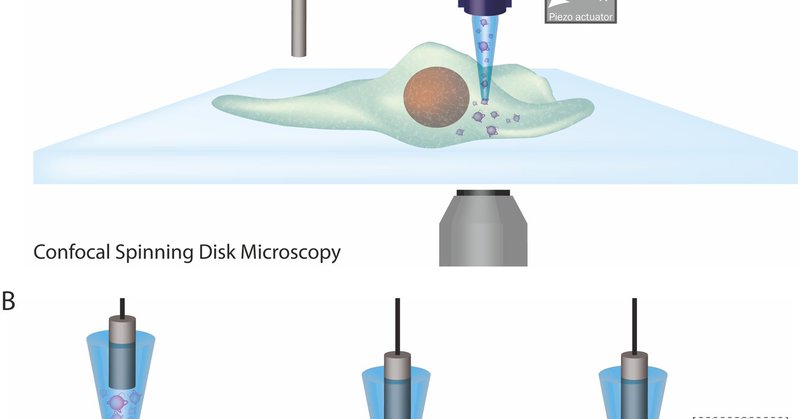
Delighted to see @chalmerscccc work at the interface of nanopore sensing and cell biology published @NatureComms . Great team effort @RadfordLab @ericcells @aksimentievLab
https://t.co/gfG0ycXIzR
nature.com
Nature Communications - Controlled manipulation of cultured cells by delivery of exogenous macromolecules is a cornerstone of experimental biology. Here, the authors describe a platform to deliver...
8
10
57
We are delighted that our Head of Department, Professor @Patrick_Unwin has been recognised for his invaluable contribution to Chemistry having just been elected as a Fellow of the Royal Society https://t.co/X4n9P15uGg Many congratulations Pat!
0
9
46
Absolutely delighted that @Patrick_Unwin is recognized for his groundbreaking work in electrochemistry and for being a fantastic mentor to so many of us.

We are very happy to announce the more than 90 exceptional researchers from across the world who have been elected to the Fellowship of the Royal Society this year, recognised for their invaluable contributions to science. Meet the new Fellows here: https://t.co/n0HZ3gwRAA
1
2
17

Our recently published tutorial review, led by @MinkyungKang87 , offers valuable insights into establishing a Scanning Electrochemical Cell Microscopy (SECCM) platform in your lab. If you're interested in this technology, check it out! @CL_Bentley, Gunani Jayamaha
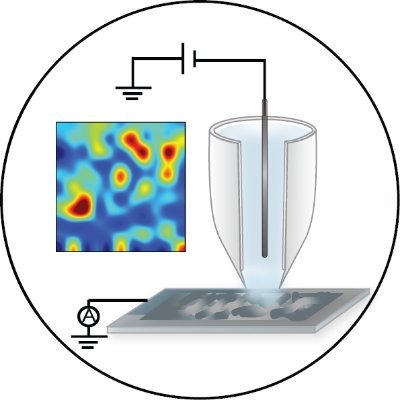
Practical guidelines for the use of scanning electrochemical cell microscopy (SECCM) https://t.co/xhBu1FjgHS
0
5
12

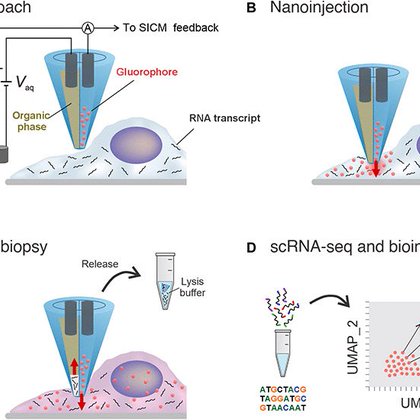
Our latest endeavour on the development of a nanobiosy approach to probe the transcriptome dynamics of brain cancer cells longitudinally, through standard therapy is out today in @ScienceAdvances
science.org
Nanobiopsy enables the multigenerational, longitudinal sampling of the same cell (and its progeny) over 72 hours.
2
7
11
Science is a team effort and @EI_single_cell has been so helpful and supportive from day one ! The @EarlhamInst is an amazing place, supporting UK scientists and providing access to world-class facilities and expertise

NEWS: A nanosurgical tool that could transform insights into cancer has been developed by scientists at @UniversityLeeds, underpinned by training on #singlecell science from the Earlham Institute. https://t.co/bhuT2Efj53
@LucyFStead @Fabio_Marcuccio @EI_single_cell
1
3
8
Out today @ScienceAdvances our nanobiopsy approach to longitudinally profile the transcriptome of brain tumour cells in vitro over 72hrs with and without standard treatment https://t.co/Z0iy8ELyXH
science.org
Nanobiopsy enables the multigenerational, longitudinal sampling of the same cell (and its progeny) over 72 hours.
5
15
70

For anyone who is interested. A super cool project translating nanopore sensing to clinical applications. The group is really supportive.
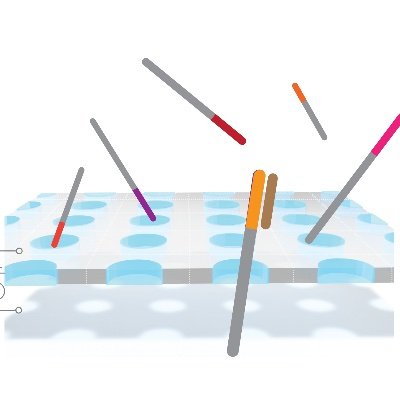
PhD position @impchemistry available in the group to develop a highly multiplexed detection approach for cancer biomarker screening from clinical samples In collaboration with @IvanovGroup @ScienceCaroloni Nadia Guerra and @nanopore To apply go to https://t.co/CvR0K1C40A
0
1
6

Brownian collision of single-entities. Maxwell Sparey and I Linz winter workshop 2024 @SENTINEL_ITN
0
1
10
We have developed the most precise "nanoinjection" setup where you can inject biomolecules into cells one at the time . Fun collaboration @RadfordLab @ericcells @aksimentievLab led by the brilliant @chalmerscccc

biorxiv.org
Controlled manipulation of cultured cells by delivery of exogenous macromolecules is a cornerstone of experimental biology. Here we describe a platform which uses nanopipettes to deliver defined...
7
16
90

Our @Warwick_Echem Alumni Minkyung @MinkyungKang87 from @Sydney_Uni was giving a fantastic talk about SECCM in electrocatalysis and corrosion at @warwickchem @BrinkertGroup @PWilsonTeam. Glad to see you again.
1
2
13

Excited to see this finally come out. Congrats to all involved (@paoloactis
@DevleenaSamanta, @pstrobbia, Christoph Wälti group), and especially to first author @SConfederat for succeeding in coordinating all of our contributions.

Check out our work on nanopore-based nanoparticle characterization, which is finally out in Small! Incredible collaboration with the groups of @MEdwardsLab, @pstrobbia, Christoph Walti, and @paoloactis! https://t.co/QetAAdGo7v
2
3
16
Nanopores have been used for decades for nanoparticle analysis based on the resistive pulse sensing scheme . Now in @AdvSciNews we report the development of conductive pulse nanopore sensors. Great work from @SConfederat
https://t.co/yPaZWvZm9b
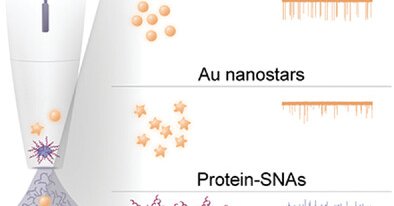
onlinelibrary.wiley.com
A new paradigm in nanopore research that takes advantage of a polymer electrolyte system and a conductive pulse sensing approach is presented. This system enables the analytical characterization of...
2
5
29

Well done, @xu_xiangdong ! It was a very nice talk, #SECCM for battery electrode characterisation! There is another talk on Thursday, @dvalavan from @Warwick_Echem 🙌 #ISE2023 # Lyon
1
2
17

A Flexible Theory for Catalysis: Learning Alkaline Oxygen Reduction on Complex Solid Solutions within the Ag-Pd-Pt-Ru Composition Space (Jan Rossmeisl and co-workers) @HEAcatalysis @SchuhmannLab #OpenAccess

onlinelibrary.wiley.com
Using combinations of machine-learning inferred input features and different prediction models, the measured catalytic activity of 1582 complex solid solution alloys within the Ag−Pd−Pt−Ru composit...
0
4
7
Very enjoyable collaboration with Marcelo Lozado-Hidalgo, Andre Geim @UoMPhysics, @UoMGraphene & team. Brilliant experimental work and analysis by @OluwasegunWahab & Enrico Daviddi @uniofwarwick State of the art electronics from Alex Colburn #OpenAccess

Research just published in Nature by @Patrick_Unwin group, @UoMPhysics, @UoMGraphene et al, solves long-standing puzzle of why graphene is so much more permeable to protons than expected by theory https://t.co/GQ1WSqYvaZ
5
12
58
Acidic Hydrogen Evolution Electrocatalysis at High-Entropy Alloys Correlates with its Composition-Dependent Potential of Zero Charge (Wolfgang Schuhmann and co-workers) @SchuhmannLab @WolfgangSchuhm9 #openaccess thanks to #projektDEAL
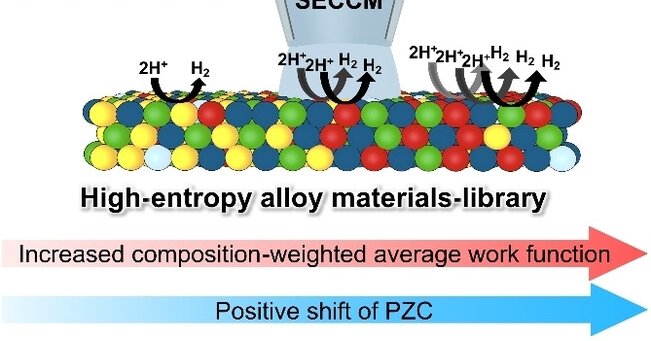
onlinelibrary.wiley.com
Scanning electrochemical cell microscopy (SECCM) experiments on a thin-film Pt−Pd−Ru−Ir−Ag high-entropy alloy materials-library (HEA-ML) reveal that the potential of zero charge (PZC) of different...
0
7
22

"4D Force Detection of Cell Adhesion and Contractility" – employing #Traction Force Microscopy and #FluidFM to investigate how forces are transmitted across human cells @LabEmerging @ETH @SENTINEL_ITN 🔬 Read the Letter today! #OpenAccess 🔓
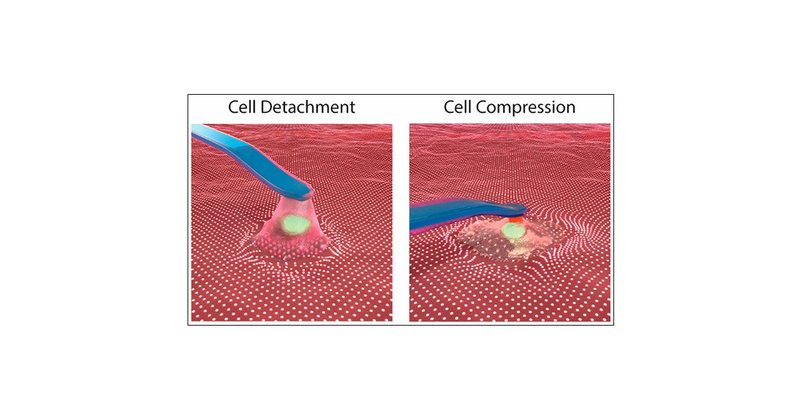
pubs.acs.org
Mechanical signals establish two-way communication between mammalian cells and their environment. Cells contacting a surface exert forces via contractility and transmit them at the areas of focal...
2
5
16