
Python Chat
@PythonChat
Followers
3K
Following
9
Media
9
Statuses
798
Live webcasts for #Python developers. Tweets by @treyhunner.
Joined April 2016

Does your company have an individual training budget that expires at the end of year? 💸 If you use #Python at work, sign up for the @PythonMorsels All Access plan and submit your training reimbursement before year end. 🐍💼 https://t.co/0YrJDd1jZ3
pythonmorsels.com
Practice a new intermediate-level Python concept every week
1
4
5
Managing a #Python team and want to chat about your team's skill trajectory? I have ideas & opinions! I'd love to chat about: 1. On-boarding new hires 📋 2. Fostering kind code style discussions 🐕 3. Learning from each other regularly 👩🏫 4. Team learning in general 🤔 DM me 💬
0
2
8
New blog post: What's great about #Python 3.10? There's some fun new features, but improved error messages are *the* winning Python 3.10 feature. https://t.co/6npvBe5sOU
8
46
121
When we use keyword/named arguments, it's the name that matters, not the position Read the full article: Keyword (Named) Arguments in Python: How to Use Them ▸ https://t.co/1SjTH1gJPc
#Python
0
2
3
Our class instantiation syntax in Python is the same as our function call syntax. Instead of "new SomeClass()" we write "SomeClass()". Because of this we use the word "function" in a fuzzy way: "function" is often used to mean "callable". https://t.co/tawEdwYt0x
pythonmorsels.com
A callable is a function-like object, meaning it's something that behaves like a function. The primary types of callables in Python are functions and classes, though other callable objects do exist.
A callable is an object that you can call. Functions are callables in #Python, but so are classes (many of the "built-in functions" are actually classes). https://t.co/4pPxKnELIi
2
3
14
In #Python, you can pass function objects as an argument to another function. In fact, some of the built-in functions, like sorted, specifically accept functions as an argument. https://t.co/QWTfJtYDzi
pythonmorsels.com
In Python, you can pass functions (as an argument) to another function. Some of Python's built-in functions actually expect functions to be given as one or more of their arguments to call them later.
0
2
7
You can break up long lines of #Python code with implicit line continuation. PEP 8 recommends relying on implicit line continuation instead of putting a \ at the end of lines to continue them. https://t.co/2j6YvxxTs3
pythonmorsels.com
Have a long line of code? If you don't have brackets or braces on your line yet, you can add parentheses wherever you'd like and put line breaks within them. We call this "implicit line continuation".
0
2
5
If you're new to list comprehensions in #Python, I recommend writing your comprehensions by copy-pasting your way from a "for" loop. This way you can anchor your understanding of comprehensions on your existing knowledge of "for" loops. https://t.co/Otrp481tlg
pythonmorsels.com
If you're new to comprehensions, I recommend copy-pasting your way from a loop to comprehension to anchor your existing understanding of for loops with your new knowledge of comprehensions.
0
6
15
What is a list comprehension in #Python? What are they used for and how are they different from a for loop? https://t.co/QdnDjvIVV0
pythonmorsels.com
Python's list comprehensions are special-purpose tools for taking an old iterable, looping over it, and making a new list out of it.
0
11
13
Something folks often ask me in my Python trainings: are immutable objects the same as constants? 🤔 They're not! 😮 Immutable objects stop you from mutating an object but constants stop you from assigning to a variable (remember: variables are pointers in Python). 🐍🍪
We have immutable objects in Python but we don't have constant variables. The UPPERCASE_CONVENTION for constants is just a naming convention in #Python. It doesn't stop variables from being re-assigned. https://t.co/GvqjyiljH4
1
5
13
A callable is an object that you can call. Functions are callables in #Python, but so are classes (many of the "built-in functions" are actually classes). https://t.co/4pPxKnELIi
pythonmorsels.com
A callable is a function-like object, meaning it's something that behaves like a function. The primary types of callables in Python are functions and classes, though other callable objects do exist.
0
4
7
Need an attribute that updates its value automatically? Use a property! In the #Python world, we tend to prefer properties over getter methods. https://t.co/YAqLn5FJLt
pythonmorsels.com
We don't use getter methods in Python, instead we use the property decorator to make make automatically updating attributes. Properties allow us to customize what happens when you access an attribute.
0
7
9
We have immutable objects in Python but we don't have constant variables. The UPPERCASE_CONVENTION for constants is just a naming convention in #Python. It doesn't stop variables from being re-assigned. https://t.co/GvqjyiljH4
pythonmorsels.com
Variables point to objects. Constant variables in other languages cannot be reassigned. We don't have any equivalent of that in Python. We have immutable objects, but not constant variables.
0
2
5
Checking an object's truthiness checks for non-emptiness and non-zero-ness. FYI: the #Python docs don't mention "truthy" or "falsey" even once. The docs call it "truth value testing" but Pythonistas rarely use that phrase colloquially. https://t.co/1QY2qqVki9
pythonmorsels.com
In Python, truthiness is asking the question, what happens if I convert an object to a boolean. Every Python object is truthy by default. Truthiness in Python is about non-emptiness and non-zeroness.
0
1
1
Instead of using hard-coded indices to get tuple elements, use tuple unpacking to give descriptive names to each item. Important items should have a name instead of a number. #Python
https://t.co/fbLOIdU2lG
pythonmorsels.com
Instead of using hard-coded indices to get tuple elements, use tuple unpacking to give descriptive names to each item. Important items should have a name instead of a number.
1
5
8
When you import a module in #Python, you'll get access to a module object with attributes representing each of the variables in that module. https://t.co/yQSSxtb5SS
pythonmorsels.com
When you import a module in Python, you'll get access to a module object with attributes representing each of the variables in that module. Python comes bundled with a bunch of modules.
0
6
11
Let's look at different techniques for counting the number of times things appear in a list. Read more 👉 https://t.co/PzgxGz04xg
#python
0
5
9
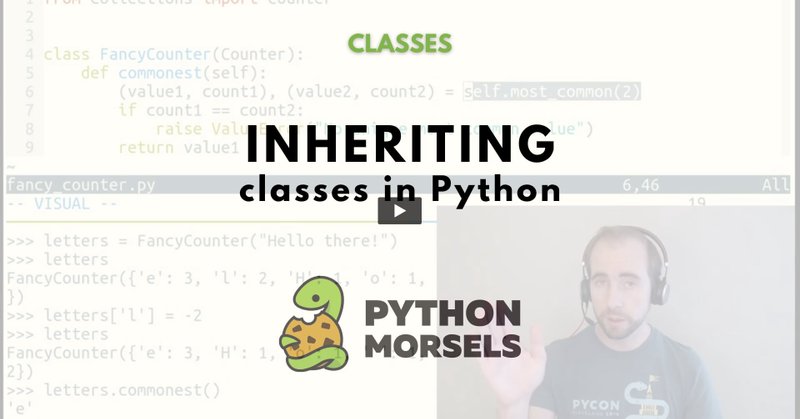
Parentheses in #Python's class & function definitions mean different things In a function definition, parentheses after the name denote the functions' arguments. In a class definition, parentheses after the name denote the class' parent classes. https://t.co/3yPqpE1QFQ
pythonmorsels.com
To inherit your class from another class, put parentheses after the class name and list parent classes. We allow multiple inheritance in Python, but we usually prefer single class inheritance.
0
2
1
Classes, modules, and functions are all mutable objects in #Python 🤯
In #Python, everything is an object. Classes are objects. Modules are objects. Functions are objects. In fact, they're all mutable objects! https://t.co/ciqhn2FiMM
0
3
10
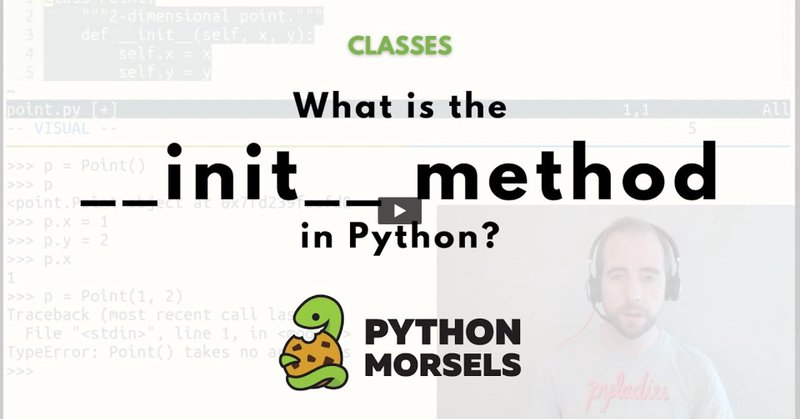
The first method you'll see in most #Python classes is the init method. This isn't a constructor method but an initializer method (because by the time init is called, a new class instance has already been "constructed") https://t.co/eJ2kQmk2Rt
pythonmorsels.com
The __init__ method is used to initialize a class. The initializer method accepts self (the class instance) along with any arguments the class accepts and then performs initialization steps.
0
8
11