
Jochen Schmon
@JochenSchmon
Followers
342
Following
475
Media
3
Statuses
40
PhD candidate @NSSRnews // 2nd Faculty @BklynInstitute // History of Political Concepts & Critical Theory
Joined June 2020
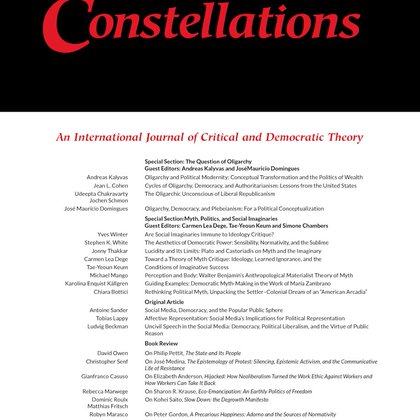
My article @JConstellations w/ Udeepta Chakravarty—part of forthcoming Special Issue on Oligarchy (w/ J. Cohen, A. Kalyvas, etc.) We inquire the “essentially oligarchic character” of the US Constitution, making Trump its illiberal radicalization 1/10
onlinelibrary.wiley.com
Click on the article title to read more.
3
24
70
In their rejection of slavery as a "private" matter, I argue that abolitionists inaugurated the true quarrel between the ancients and the moderns—making possible radical conceptions of patriarchy and capitalism as different, but interrelated forms of the "tyranny" of slavery
0
0
5
Here, I focus on 18th century abolitionist writings, theorizing them as acts of translating the Caribbean slave revolts into the imperial public spheres—the very sites of empire that would also become the discursive staging ground of radical feminist and proletarian movements
1
0
5
My @PolConcepts article "Abolition" is published: https://t.co/eCHnW1buXW—first sketch of my dissertation that explores the conceptual reverberations of the abolitionist movement in the philosophy of the Enlightenment as well as in early feminist and proletarian movements
1
2
7
Spanish translation of my @JHIdeas interview with @alybatt at @SinPermisoInfo: "Free Gifts: Capitalism and the Politics of Nature" @PrincetonUPress
https://t.co/WXi5ugLBYf

sinpermiso.info
Alyssa Battistoni ha publicado recientemente el libro Free Gifts: Capitalism and the Politics of Nature (Princeton University Press, 2025), que propone un análisis teórico-valoral, más que moral, de
0
2
2

Really enjoyed this conversation with @JochenSchmon at the @JHIdeas blog about naive materialism, environmental justice, capitalist unfreedom, political commitments, and other questions raised by Free Gifts
jhiblog.org
by Jochen Schmon
0
7
27
Instead of “environmental side-effects” or the economy’s “external byproducts,” it is the “ability to impose pollution on others that is another aspect of class power—and the inability to refuse it a form of unfreedom in its own right”
0
0
2
Against the "naïve materialism" that is so-called new materialism and the "moral naturalism" of much Marxist ecology & social reproduction theory - in favor of a critical denaturalization of social relations without "dematerializing" them
0
0
1
I interviewed @alybatt on her new book "Free Gifts: Capitalism and the Politics of Nature" @PrincetonUPress for the JHI blog: “Class rule consists in the power to produce the environment itself." https://t.co/HqtYe2cnp6
jhiblog.org
by Jochen Schmon
2
14
41

New on JHI Blog: interview with Alyssa Battistoni (@alybatt) on her new book Free Gifts, a value-theoretical study of capitalism's appropriation of nature. @JochenSchmon asks about the "new materialism," reproductive labor, existentialism, and activism.
jhiblog.org
by Jochen Schmon
0
1
3
Glad to see our @JHIdeas interview in its French translation!

📖Marx et le républicanisme. Entretien avec @BrunoLeipold A l’occasion de la sortie de son livre Citizen Marx, Bruno Leipold analyse le développement intellectuel de Marx à travers ses rapports avec le républicanisme du XIXe siècle. https://t.co/zaDfqUzOre
1
0
3
Is the liberal-republican ‘common good’ not the good of the oligarchs, with the rich continuing to be rich & the poor continue to be poor? The good of democracy is not the good of all, for the poor's good is the wrong to all the other parts that are merely—and only—the rich 10/10
1
0
4
Shays’ Rebellion as the return of the repressed oligarchic unconscious of the Federalist debate: Popular struggles against economic inequality exposed the oligarchic nature of liberal republicanism in its constitutional exclusion of the majority from government 9/10
1
0
4
The majority of citizens, which are poor, could not be politically trusted with their “rage for paper money, for an abolition of debts, for an equal division of property” (Madison)—an implicit reference to demands of the Massachusetts Peasant Rebellion led by Daniel Shays 8/10
1
0
6
Liberal Republicanism & the Constitutionalization of Oligarchy: Federalist proponents were not only perfectly aware of the oligarchic possibilities of their Constitution, but they even preferred to pave the way for the rich for public office as the ‘most virtuous’ citizens 7/10
1
0
4
Antiquity conceived the rich as incapable of virtuous government, for modern liberals and republicans they are the ‘incarnation of virtuous character’—and thus the part of the citizenry most likely tending to govern in the common interest 6/10
1
0
4
Liberalism’s oligarchic unconscious: Adam Smith not only naturalizes, against the ancients, oligarchic desires as the ‘human condition’ but even claims the individual pursuit of economic self-interest as the ‘invisible’ condition for the achievement of the ‘common good’ 5/10
1
0
4
Ancient & modern republicans see economic inequality as the central antagonism. But while oligarchy is seen as internal danger (republics only authorize ‘a few’ to rule, thus open to the rich) democracy is an external threat (republics always exclude ‘the many’ from ruling) 4/10
1
0
4
We reconstruct the oligarchic unconscious in Aristotle’s ideal Mixed Regime where, similar to modern republics, the ‘virtuous few’ should rule impartially against the direct participation of the rich (oligarchy) and the poor (democrats) 3/10
1
0
4