
Jaap van Schaik
@JaapvSchaik
Followers
202
Following
305
Media
18
Statuses
70
this account is dormant, find me @jaapvschaik.bsky.social
Joined August 2017
Absolute bucket list moment! Seeing our work on BatNet spectacularly illustrated by the folks at @RSECJournal 😍🦇

BatNet: a deep learning-based tool for automated bat species identification from camera trap images Watch our short animated video based on the paper by @GabiKrivek et al. https://t.co/ZdbGGpkcFO
0
2
16
Implications: if a hibernaculum is disturbed or destroyed, our observations suggest most Natt/Dau bats do not have a backup plan in place! So mitigation measures that compensate for the loss of a site with the creation/upgrade of another should be approached with extreme caution.
1
0
0
What’s more, at one of the sites, three entrances were simultaneously monitored, and even within-site it appears most bats stuck to the one entrance they knew, and rarely explored the others in the immediate vicinity.
1
0
0
To explore whether bats were leaving for unmonitored sites, we also compared the disappearance rates (tagged individuals that were never sighted again) to published mortality estimates for both species. tl;dr: nope!
1
0
0
When movements did occur, they almost exclusively occurred in autumn, and juveniles moved more than adults. In fact, the annual movement rate of adult bats was <1% in both species. Never change a winning strategy, it seems.
1
0
0
In this study, the entrances of three hibernacula were monitored with RFID-readers, and the movements of over 2500 marked bats were tracked over 8 years. In total, only 17 of the 1081 Daubenton’s bats and 59 of the 1425 Natterer’s bats were ever recorded at a second hibernaculum
1
0
0
New paper! 🦇❄️💤 How often do bats scout and switch hibernacula? For Natterer’s and Daubenton’s bats it turns out, almost never. https://t.co/43Ldgb751u Based on the brilliant long-term monitoring being led by Frauke Meier at @BatResearch_HGW, and published in @AnimalConserv
1
12
26

Biodiversiy is declining, yet we have limited knowledge about how that affects human well-being. My work linking bats, insecticide use, and human infant health is out today in Science ( https://t.co/gNIbWRdqEj), and tells a complex story about how those are connected.
25
588
1K
Check out this gorgeous infographic summarising the highlights Gabi's PhD thesis. Looking forward to all the new adventures and results we can achieve with this 🦇 monitoring tool!
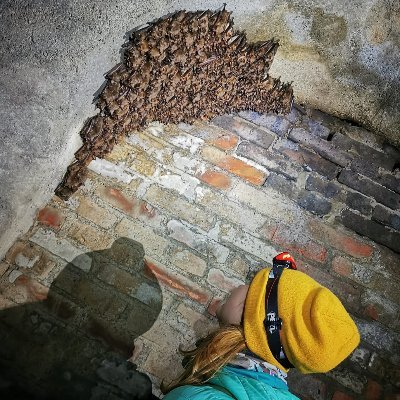
🦇📸Wondering how we can use cutting-edge techniques to automatically monitor #biodiversity? Let’s peek into the world of light barriers, #cameratraps and #deeplearning to explore the intricate world of #bats and gain invaluable insights into their behavior at hibernation sites.
0
0
8
The deadlines for these 2 #PhDposition's has been extended to July 20th! As before, happy to answer any questions about the positions or the group :) official advert here:
Announcing 2 new #PhD positions in our 🦇lab! Monitoring bat population trends is hard. In a new project, BatTrend, we will explore both new methods and optimize established ones to help improve monitoring guidelines. Info about the 2 positions in the 🧵 below. RTs appreciated!
1
4
1

|| NEW RESEARCH || Heat over heritability: Increasing body size in response to global warming is not stabilized by genetic effects in Bechstein's bats 📄 https://t.co/X1xGwbOx1q
@BatResearch_HGW
0
7
20
links to the advertisements in English: https://t.co/Ax2XBfHkfZ
https://t.co/bE2smfUCvN
0
0
0
Application deadline is soon: 10th of July. Links to the adverts are in German, but will be updated with the English text soon. Feel free to get in touch if you have any questions!
1
0
3
Overall, BatTrend will be composed of modules looking at both summer and winter monitoring (counts, marking, light barriers, long-term passive acoustics, eDNA), as well as continue the work of https://t.co/Ukq0LAvkmn to compile and provide these data to all.
1
0
2
The other will explore two new monitoring methods: long-term passive #acoustics, and #eDNA (together with @Helmholtz_HIOH). This project has it all! Fieldwork, labwork and coding/stats. With support from a great group of advisors of course. https://t.co/sNHxHv7niW
1
1
6
One position will use high-resolution long-term monitoring data to develop monitoring guidelines for forest-dwelling #bats. They’ll also spend the summers collecting the data (so lots of fun in the ☀️/ 🌧️). https://t.co/t6Nb8BSUOa
1
0
4
Announcing 2 new #PhD positions in our 🦇lab! Monitoring bat population trends is hard. In a new project, BatTrend, we will explore both new methods and optimize established ones to help improve monitoring guidelines. Info about the 2 positions in the 🧵 below. RTs appreciated!
3
17
37
She did it! It's been a wild ride, but oh so worth it. Congrats Dr. Krivek.
0
0
3
And as a little teaser, in sister species Polychromophilus murinus, which infects vespertilionid bats, the pattern is very different! More on that soon, in another great collaboration with @SchaerJuliane
0
2
3
When we look at how the observed genotypes fit into the known diversity of the species, they’re all over the haplotype network! This suggests there’s a lot of transmission of Polychromophilus across the range of miniopterids from Europe, Africa and Asia.
1
1
1