
Bingjun Xu
@BingjunXu
Followers
715
Following
136
Media
7
Statuses
38
LiGeZhaoNing Chaired Professor of Physical Chemistry at Peking University, Catalysis, In-situ/Operando Characterizations, and Renewable Energy & Chemicals
Beijing China
Joined October 2019
Our recent mechanistic investigation of the electrochemical CO reduction on Cu suggests C-C coupling is no the rate limiting step. Reaction order of adsorb CO never reaches 2 despite of our best efforts. Check it out at: https://t.co/SP2Ez3elLi
2
0
23
Happy to share our recent work on the cation effect in the CO2RR, which is highlighted as a cover work in @ACSCatalysis We show that an existing theory is unlikely to hold but truth of how cations impact electrocatalytic reactions is still out there! https://t.co/Ynx0JyUa0f
0
7
72
Happy to share our latest collaborative work with Prof. Qi Lu's group @Tsinghua_Uni on electric field and non-electric field modes of the cation effect in electrocatalysis via combined reactivity and spectroscopic investigations. @ScienceAdvances
0
1
30
Check out our latest work with Qi Lu @Tsinghua_Uni showing coelectrolysis of CO2 and O2 enhances C2+ production. In situ SERS again demonstrates its capability to identify key surface intermediates. @UDChBE
nature.com
Nature Communications - While the electrochemical conversion of CO2 to highly reduced products is unique to copper, there are still gaps in understanding copper catalysts’ efficacy. Here,...
0
6
51
Another of our recent works highlighted in as the journal cover!

Cover: Stability of the ketyl radical as a descriptor in the electrochemical coupling of benzaldehyde – free to read for six weeks! Led by Bingjun Xu, https://t.co/gIJtnF8qv2
1
2
21
Excited to have our recent in situ SERS work with @Jiao_Lab and Dean Levi Thompson highlighted as a cover of @J_A_C_S ! @UDChBE @UDengineering
2
6
105
Excited that our work on zeolite encapsulated metal NPs for selective tandem catalysis has been highlighted in the @ACSCatalysis cover @UDengineering @UDChBE @CatalysisCenter: https://t.co/EDEsozDEr0
0
3
27
Check out new work in collaboration with @PengBai0507 on the solvent effect on the adsorption and protonation in porous catalysts @UDChBE @UDengineering:
0
3
24
Our work on the role of hydroxide (or the lack of) in the CO reduction reaction in collaboration with Qi Lu's group @Tsinghua_Uni has been highlighted as the cover of @angew_chem. @UDChBE @UDengineering
https://t.co/SZyrgMVGUV
0
2
21
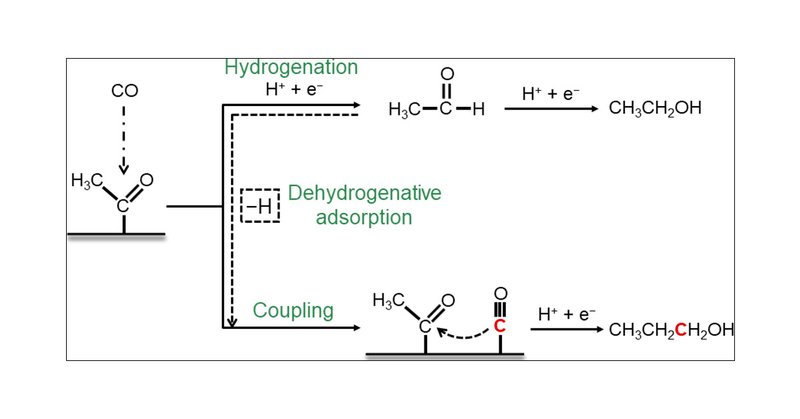
Check out our new work on electrocatalytic C-C coupling between CO and acetaldehyde. @UDelaware @UDengineering Quantitative NMR analysis is informative but exhausting... https://t.co/x4Q4Qyirvq
pubs.acs.org
Production of valuable multicarbon (C3+) products through the electrochemical CO2 and CO reduction reactions (CO2RR and CORR) is desirable; however, mechanistic understanding that enables C–C...
2
8
47

Mix Chicken poo with #graphene and you get superdoped #electrocatalyst. See our paper: Will Any Crap We Put into Graphene Increase Its Electrocatalytic Effect? Will humanity start [trade]war over highly valuable chicken guano? https://t.co/RA7nBU8P86
@acsnano @VSCHT @CEITEC_Brno
pubs.acs.org
24
218
690
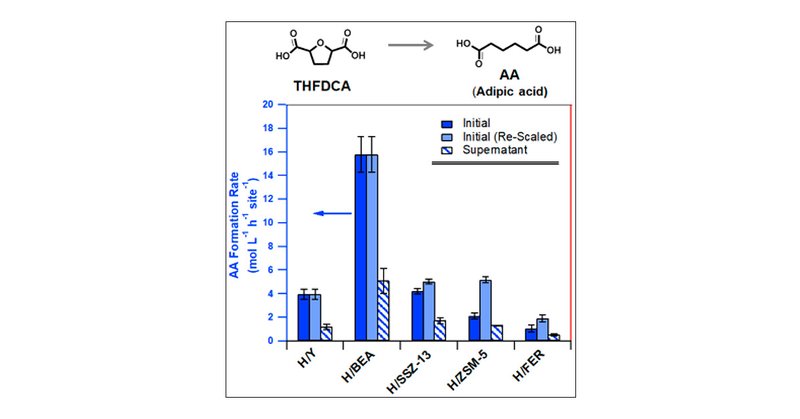
First paper in 2020 came out on renewable adipic acid production @UDChBE, and it came out two years after the first author (Matt Gilkey) graduated! https://t.co/65qdf7QMwe
pubs.acs.org
Adipic acid (AA) is an important precursor for the production of Nylon-66, and renewable routes for AA are being explored. Previously we have shown the use of HI and molecular H2 to be an effective...
1
1
26
Our recent work @UDChBE in @ACSCatalysis demonstrates the molecular intimacy between acid and metal sites is key to mediating tandem catalysis:
pubs.acs.org
The proximity of different catalytic sites is key to selective catalysis; however, the controlled placement of multiple types of active sites is synthetically challenging. In this work, we show that...
0
4
24
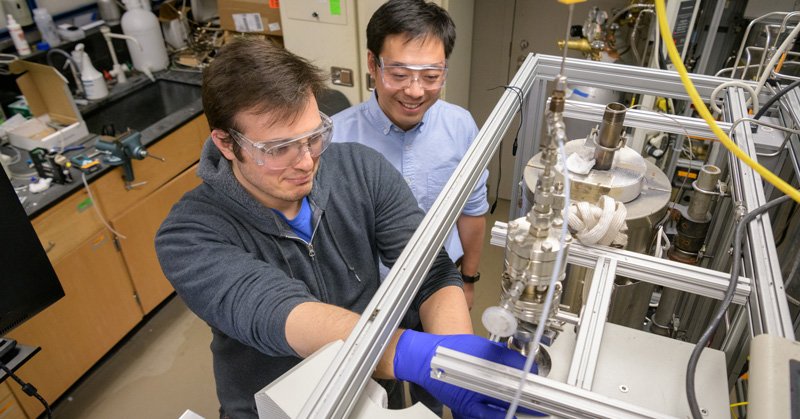
Greenhouse gas for good | UDaily
udel.edu
Engineers reveal new way to capture carbon dioxide and use it cleanly and efficiently
1
0
13
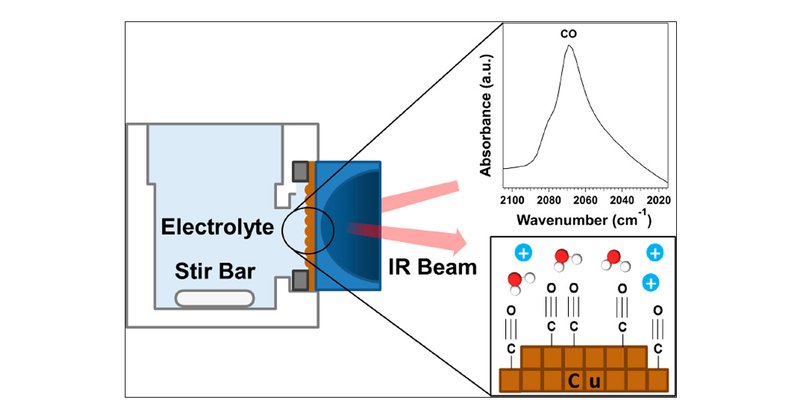
Our work @UDChBE @UDengineering on the impact of the forced convection on spectroscopic observations in CORR came one line in @ACSCatalysis. The key take home message is that stirring matters in correlating spectroscopic with reactivity results.
pubs.acs.org
The electrochemical CO reduction reaction (CORR) has been shown to suffer from mass transport limitations owing to the low solubility of CO in aqueous electrolytes (∼1 mM). However, no direct...
2
2
28
Our latest work @UDChBE in collaboration with Qi Lu's group @Tsinghua_Uni on the role of hydroxide (or the lack of) in CORR came out with a provocative title😎
0
0
10
Had a great time with current and former students at 2019 Xu group holiday party last night!
0
0
15

A 50y old memo wrote by our department legend T W Fraser Russell, who passed away last week. Some good points are still relevant even after almost fifty years.
3
3
33