
African Affairs
@AfrAfJournal
Followers
12K
Following
285
Media
6
Statuses
762
African Affairs is the top ranked journal in African Studies Editors: @S_de_Oliveira | @AmbreenaManji | George Bob-Milliar By @OxUniPress for @RoyAfriSoc
Joined December 2015
The article demonstrates that even if an elite-level pact is in place, a lack of connections between national-level elites and local conflict parties can prevent peace from trickling down from the national level to the local level.
0
0
3
It argues that extreme state weakness and a highly fragmented patronage-based system have prevented national-level peacemaking efforts from having a positive impact on local peacemaking efforts in the Central African Republic.
1
0
2
This article studies national-level and local peacemaking efforts in the Central African Republic and contributes to the literature on conflict resolution. Many studies have focused on the local peace process, yet the national-level context in which these take place is neglected.
1
0
0
Just published Allard Duursma @AllardDuursma State weakness, a fragmented patronage-based system, and protracted local conflict in the Central African Republic @OUPPolitics @OxfordJournals
https://t.co/RQFY4wwp01
academic.oup.com
Abstract. There is an academic consensus that addressing the local cleavages that drive armed conflict through local peacemaking is crucial to building pea
3
5
9
The authors argue that efforts intended to combat the spread of misinformation need to move beyond the Western-centred conception of what constitutes media and take different local modalities of media access and fact-checking into account.
0
0
3
This paper sets out how social, traditional, and pavement media form a complex and deeply gendered and socio-economically stratified media ecosystem and investigates its implications for how citizens differentially encounter, process, and respond to misinformation.
1
0
5
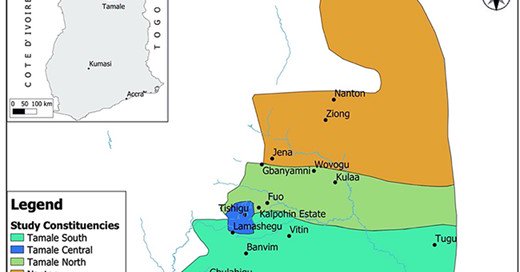
Drawing on research in northern Ghana, this paper argues that the everyday communication of current affairs through discussions in marketplaces, places of worship, bars, and the like is a key link in a broader media ecosystem.
1
0
0
Just published. Misinformation Across Digital Divides: Theory And Evidence From Northern Ghana by @EllieGadjanova @GabrielleLynch6 Ghadafi Saibu @OUPPolitics @OxfordJournals
https://t.co/xRDpCn6ulm
academic.oup.com
Abstract. Social media misinformation is widely recognized as a significant and growing global problem. Yet, little is known about how misinformation sprea
2
4
15
As Dr Peace Medie @PeaceMedie completes her term as editor, our sincere thanks to her. Our authors and reviewers will know the hard work and dedication with which she has guided the journal. We owe her a great debt.
1
3
22
We are delighted to announce that Dr George Bob-Milliar, Department of History and Political Studies, Kwame Nkrumah University of Science and Technology, has joined us as an editor of African Affairs. Welcome to the editorial team and we look forward to working with you.
3
19
106

Also trending in #PoliSci: https://t.co/8i0zGPHkKC • Love & Care for Remaking Worlds (@IntlStudiesRev) • Indian Foreign Service under Hindu Nationalist Rule (@IAJournal_CH) • When Coethnicity Fails (@World_Pol) • Wealth & Power In Tanzania’s Parliament (@AfrAfJournal)
2
4
8
This suggests that informal property rights documents can be a powerful tool in a citizen’s arsenal. Further, these findings illustrate a process of adaptation and change within customary land institutions.
1
0
1
Evidence from 121 interviews with chiefs, bureaucrats, and smallholder farmers and a survey of over 5,500 citizens shows that, despite their flaws, chiefs’ titles do increase citizens’ perceptions of tenure security.
1
0
1
However, chiefs’ titles are extra-legal: they are enforced by the same traditional leaders who govern unwritten customary rights, raising doubt about whether written land rights can strengthen citizens’ land claims without changing the existing power structures.
1
0
0
It argues that entrepreneurial chiefs have created written land rights for citizens on customary land in the form of letters, signed maps, and certificates. These documents are an alternative to state land titling that allows chiefs to maintain their control over land.
1
0
0
Just published: 'The power of the pen: Informal property rights documents in Zambia' Lauren Honig @BostonCollege
https://t.co/jyscHXN8c7 This article explores the expansion of informal property rights documents through the case of chiefs’ titles in Zambia.
1
4
7
Trending in #AreaStudies: https://t.co/IQ6X9mH4XM 1) Perceptions of Lebanese Political & Intellectual Elites toward Iran 2) Wealth, Power & Institutional Change In Tanzania’s Parliament (@AfrAfJournal) 3) Under-Protection & Popular Support For Police Violence In Nairobi
0
2
0
Great thread from @MCollord on her paper just published.

Happy to see this out! I would normally recap key points from the article here, but the AA thread does a lot of the work for me.
0
2
1
Great thread from @MCollord on her paper just published.
Happy to see this out! I would normally recap key points from the article here, but the AA thread does a lot of the work for me.
0
2
1
Exploring elite power struggles the paper demonstrates that these vary with changes in the extent of private wealth accumulation and the expansion of rival patron–client factions.
0
2
5